
By going vegan, adopting soil-sustaining strategies and reining in our population growth, we can sustain ourselves for millennia
Roughly 10,000 years ago modern agriculture was born in the ‘fertile crescent,’ an area called Mesopotamia that centered around what is now known as Iraq. Most of the staple crops we eat today have their origins in that area. Grains, beans, peas, carrots – they’re all derived from plants indigenous to the fertile crescent. Mesopotamia was the richest, most innovative society on earth. We all have a massive debt to those ancient farmers.
Their early project – along with similar ones in ancient China and Mesoamerica – led to the very possibility of the modern world. Without their amazing innovations and hard work, we would not be feeding so many of the billions of people who now live on this Earth.
Indeed, without the innovations these people brought, civilization as we understand it could never have taken hold. Sadly, though, those early innovators didn’t get it quite right. Today, the fertile crescent is anything but fertile. Deforestation slowly led to massive soil erosion; salts poisoned the soil as irrigation waters evaporated away. Now, much of the area is desert.
It’s a pattern that has sadly repeated throughout history. Over and over again, we humans have exploited our lands to the point of exhaustion. The Anasazi of the American southwest would farm an area for a few decades then farm new land as the old lost its fertility. Many tropical societies do the same today. The problem with this approach is that eventually you run out of new land to move on to. The Anasazi ran out. So did the Easter Islanders. Their societies collapsed.
And, sadly, we still haven’t managed to get it quite right. But there is hope.
We’ve honed our methods very well over the millennia. We’ve learned how to modify the land, to make it yield so much more food per acre, to be much more capable of providing the food we need. We’ve bred plants that grow more quickly and provide more food per acre. In some ways, we’ve been spectacularly successful.
Indeed, the ‘Green Revolution’ of the 1960s led to an explosion in productivity and has without doubt allowed many, many more humans to live on this planet at one time than would otherwise have been possible. Norman Borlaug very much deserved the Nobel Prize he received for making that revolution real. Billions of us would not be here today without his innovation. Borlaug was, nevertheless, worried.* He had good reason to be.
Despite all of his work, we’re still on a trajectory very similar to those of so many ancient civilizations. Borlaug bought us time. It’s up to us to use it as we should.
Most pressingly, we’re quite literally eroding away the very possibility of maintaining ourselves. Our practices are causing the soil on which we all depend to disappear. And it’s happening shockingly fast.
Cornell University’s David Pimentel has well documented the soil erosion we are causing. The United States is losing soil 10 times faster than it can be replenished; the rate of soil loss in China and India is over three times that. Pimentel reports that over just the last four decades of the 20th century, some 30% of the world’s arable land became unproductive. Half of the topsoil in the breadbasket of North America has been lost since 1900.
The United Nations is similarly alarmed. In 2014, their Food and Agriculture Organization warned that we are running out of time to deal with the threat. As reported in Scientific American at the time, “Unless new approaches are adopted, the global amount of arable and productive land per person in 2050 will be only a quarter of the level in 1960, the FAO reported, due to growing populations and soil degradation.”
All in all, it’s very frightening. But it’s not too late. We can fix this. As Pimentel says, “controlling soil erosion is really quite simple: The soil can be protected with cover crops when the land is not being used to grow crops.”**
Add to that a move to a low impact food system – and we can create a world in which we can maintain ourselves for millennia. That system would be vegan.
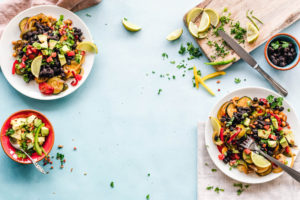
Almost 80% of agricultural land – and a huge proportion of our crops – is used to feed animals. That is outrageously inefficient – requiring many times as much plant life to feed us than were we to simply eat plants directly. Recent research (summarized here and here) has shown that we can feed ourselves very well on dramatically less land if the bulk of humanity was simply to switch to vegan diets.
So let’s do it!
We have time, but not a whole lot of it. It will take serious effort on our part and on the part of those around us. We’re going to have to change our eating and our farming practices. Realistically, we’re also going to have to reproduce less and slowly reduce our population. Either we take advantage of our intelligence and human compassion and do what is necessary or nature will do it for us in a very, very unpleasant way. There’s no good reason to let the latter happen.
Here’s a brief summary of the basic actions we can take to help ensure rewarding, healthy lives for all of us:
- Be vegan. It takes many times more grain (and, thus, more soil nutrients) to eat meat and other animal products than to get the same protein and other nutrients directly from plants.
- Practice birth control. If we want a lot of humans to experience the joys of life on this planet, it is far better that we spread them over many, many generations than crowd them into a few miserable ones.
- Spread the word. Speak with your friends. Let your government representatives know how important it is to take action. Support others working to get the word out – like Earthsave Canada.
Notes
* In his Nobel lecture Norman Borlaug exhorted “The green revolution has won a temporary success in [our] war against hunger and deprivation; it has given [us] a breathing space. If fully implemented, the revolution can provide sufficient food for sustenance during the next three decades. But the frightening power of human reproduction must also be curbed; otherwise the success of the green revolution will be ephemeral only. Most people still fail to comprehend the magnitude and menace of the “Population Monster.””
** Realistically, widespread adoption of some form of no till agriculture will also be essential – something that Pimentel was very aware of, but that the journalist failed to report.
Photo by Bence Balla-Schottner on Unsplash