
• Why Plant-Based?
    • Overview
    • Sustainability
    • Better health
    • Compassion for animals
  • Resources
    • Virtual speaker series
    • Speakers program
    • Pamphlets
    • Newsletters
  • Blog
  • About Us
    • Who we are
    • Contact us
  • How to Help
    • Join us
    • Donate
  • Subscribe to Newsletter
Earthsave CanadaEarthsave Canada
  • Why Plant-Based?
    • Overview
    • Sustainability
    • Better health
    • Compassion for animals
  • Resources
    • Virtual speaker series
    • Speakers program
    • Pamphlets
    • Newsletters
  • Blog
  • About Us
    • Who we are
    • Contact us
  • How to Help
    • Join us
    • Donate
  • Subscribe to Newsletter

Better Health

It is well-accepted by health experts that a plant-based (vegan) diet can provide all the nutrients we need.

Both the Dieticians of Canada and the U.S. Academy of Nutrition and Dietetics agree that appropriately planned plant-based diets are healthful, nutritionally adequate, may provide health benefits in the prevention and treatment of certain diseases, and are appropriate for all stages of life.1,2

The World Health Organization reports strong evidence that a diet low in meat, eggs and dairy, while also higher in fruit and vegetables, was associated with a lower risk of heart disease, type 2 diabetes, stroke and various types of cancer.3 The volume of evidence that vegan diets have major health benefits is enormous.4,5 A plant-based diet rich in fibre, folic acid and antioxidants is also associated with lower cholesterol, blood pressure and body fat.6

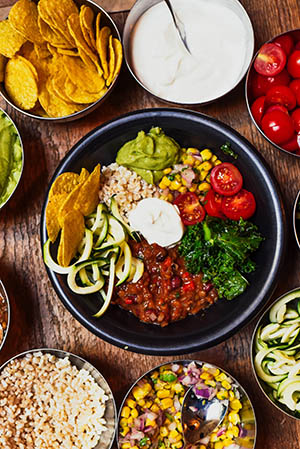
A plant-based diet rich in fibre, folic acid and antioxidants is also associated with lower cholesterol, blood pressure and body fat.

The Canadian Cancer Society recommends increasing our intake of high fibre foods such as whole grains and legumes.5 Canada’s Food Guide recommends including plenty of vegetables and fruits in our diet; when you eat, half of your plate should be vegetables and fruits.7

Research also suggests that a plant-based diet may reduce the number of medications patients need to take to treat a variety of chronic conditions.8

It is crucial to note that you must eat B12-supplemented foods or take a vitamin B12 supplement while on a plant-based diet, as there is no reliable plant source for vitamin B12. But don’t worry – the B12 found in supplements is sourced from bacteria, not from animals.

Research also suggests that a plant-based diet may reduce the number of medications patients need to take to treat a variety of chronic conditions.

To learn more about vegan nutrition, check out these great resources, and also visit our resources page to find our brochures with specific information on where to get your protein, calcium, and iron on a plant-based diet.

  • Vegan Diet information from HealthLinkBC
  • Vegan Health – Evidence-Based Nutrient Recommendations
  • The Vegan for Life Food Guide
  • Brenda Davis, RD
  • Vesanto Melina, MS, RD

References

  1. Position of the American Dietetic Association and Dietitians of Canada: Vegetarian diets, Journal of the American Dietetic Association 103:748-765, 2003. https://pubmed.ncbi.nlm.nih.gov/12778049/
  2. Position of the Academy of Nutrition and Dietetics: Vegetarian Diets, Journal of the Academy of Nutrition and Dietetics 116:1970-1980, 2016 https://www.eatrightpro.org/-/media/eatrightpro-files/practice/position-and-practice-papers/position-papers/vegetarian-diet.pdf
  3. World Health Association Technical Report Series, #916. Diet, Nutrition and the Prevention of Chronic Diseases https://apps.who.int/iris/bitstream/handle/10665/42665/WHO_TRS_916.pdf
  4. Dinu, et al., Vegetarian, vegan diets and multiple health outcomes: A systematic review with meta-analysis of observational studies, Critical Reviews in Food Science and Nutrition, 57:17, 3640-3649, 2017, DOI: 10.1080/10408398.2016.1138447.
  5. Tuso, P.J., Nutritional Update for Physicians: Plant-Based Diets, Permanente Journal 17:61–66, 2013 https://www.ncbi.nlm.nih.gov/pmc/articles/PMC3662288/
  6. Appleby, et al., Hypertension and blood pressure among meat eaters, fish eaters, vegetarians and vegans in EPIC–Oxford. Public Health Nutrition, 5(5), 645-654. doi:10.1079/PHN2002332.
  7. https://www.cancer.ca/en/about-us/news/national/2016/get-friendly-with-fibre/
  8.  https://food-guide.canada.ca/en/

Photo credits

  1. Photo by RF._.studio from Pexels
  2. Photo by Ralph (Ravi) Kayden on Unsplash
Donate

Recent Posts

  • United Nations Environment Program: The World is In Grave Danger – But We Can Save It … and Thrive!
  • 2025 State of the Climate Report: A dire reality that we CAN turn around!
  • COP 30: The impacts of animal agriculture on the climate
  • Meat industry influence may lead to biased conclusions in nutrition studies

Follow us

Engage with us on facebook

Earthsave Canada

Earthsave Canada

14 hours 32 minutes ago

"For centuries we have assumed that our complex language, sophisticated technologies, extensive social networks and other attributes puts us in a class of our own.

1
View on Facebook
Share
Earthsave Canada

Earthsave Canada

16 hours 29 minutes ago

"Ethics demand we question: if alternatives abound, why perpetuate harm? Humane Foundation Article on Ethics Beyond Politics argues sentience—proven in animals via pain receptors, memory,

1
View on Facebook
Share

Earthsave Canada

19 hours 20 minutes ago

"This shift follows the 2024 update to the country’s national nutrition guidelines, which focused on foods that benefit both health and the environment. Recent data

Finland sees tofu sales soar following new nutrition guidelines

Finland's plant-based market is experiencing a surge as official health recommendations encourage citizens to swap sausages for soy and lentils.

1
View on Facebook
Share

© 2026 · Earthsave Canada.