
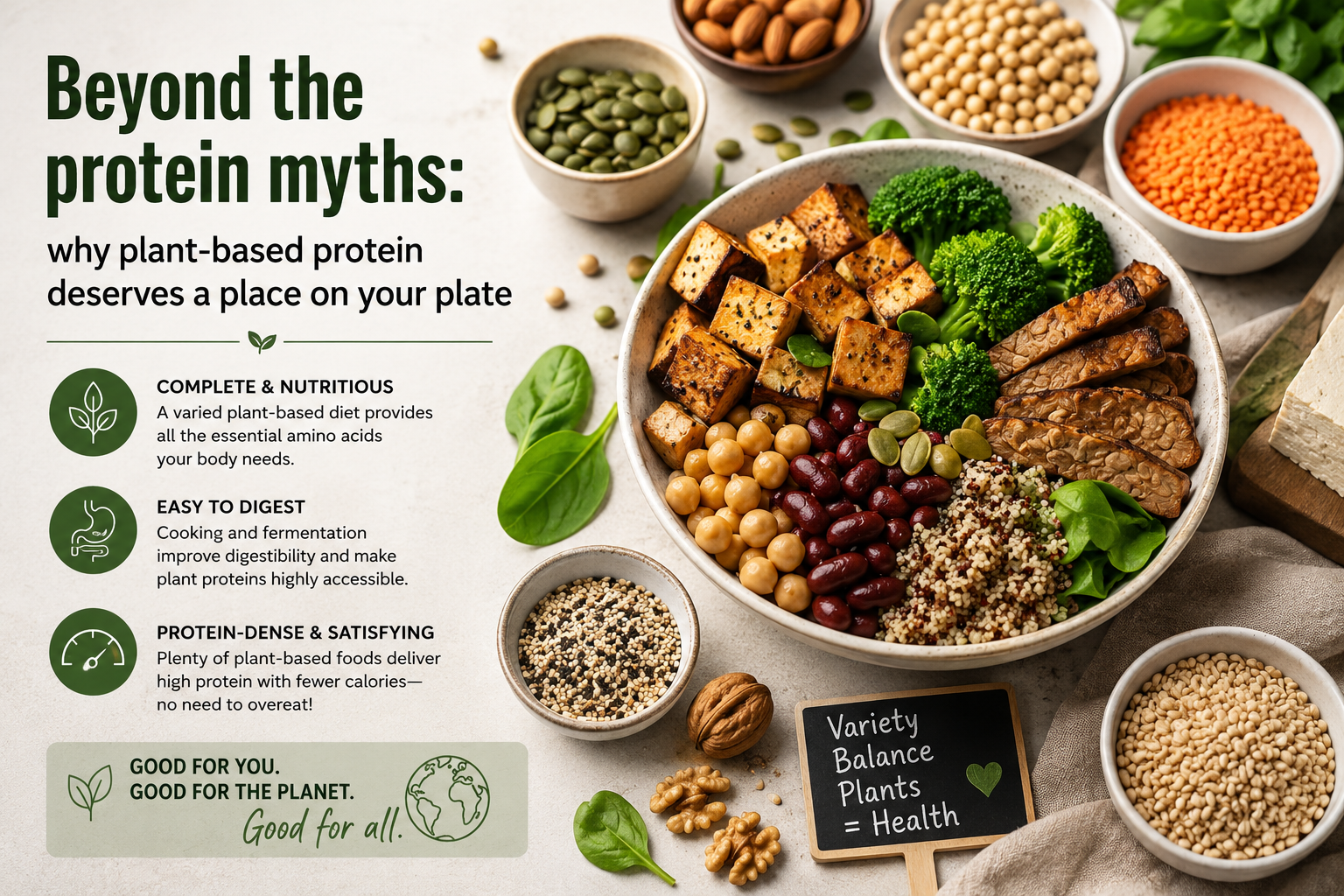
Protein is, without a doubt, the superstar of modern nutritional spin. Aided by the increasing emphasis on healthy lifestyles, protein-rich products have become increasingly common on our shelves [1] [5]. The plant-based world has been no exception, and nowadays the high protein options available from vegetable sources are definitely greater than it was even just 10 years ago [4].
Yet, there seem to be stigmas that prevent many people from even integrating more plant-based sources in their diet.
“But where do you get your protein?”
“How do you handle the lack of essential amino-acids?”
These are just some of the most common questions people ask when approaching the plant-based world. To be completely honest, I wondered the same things for quite a long time before switching to a mainly plant-based diet. My doubts were shaped by the common belief that animal proteins are simply better and more bio-available. On top of that, I was afraid that a plant-based diet would have been incredibly complex to manage – and probably more expensive too.
How wrong I was! As often happens in life, the reality is more nuanced than what one would expect.
Let’s examine a few of the most common misconceptions:
- Plant-based proteins are less complete than animal ones: true, but only if we look at single foods in isolation.
The proteins in our body are built by assembling smaller “blocks” called amino acids (AA). Out of the 20 AA that our body needs, 9 are considered essential because they either cannot be synthesized by our body or we cannot produce them in sufficient amounts; therefore, we need to obtain these 9 AA through the foods we eat [6].
It is true that animal-based proteins are “complete” since they contain all the essential AAs [2]. That said, while most plant-based sources are lower in specific essential AAs when considered on their own [2], there is no problem obtaining all of them if we simply eat a varied plant-based diet.
Studies clearly show that complementary proteins do not need to be eaten in the same meal to meet our needs [7]. What really matters is the overall quality and variety of the diet across your day [7]. A well-rounded plant-based diet that includes varied protein sources – such as tofu, seitan, legumes, tempeh, soy, nuts, seeds, and grains – can easily provide all the essential AAs we need [8]. In conclusion, a plant-based diet can absolutely do the job!
- Plant-based proteins are often less digestible than animal proteins: true, but it’s not a real problem.
Plant-based proteins tend to be less digestible because they are often embedded within plant cell walls and can contain compounds – such as phytates, tannins, and protein inhibitors – that reduce protein accessibility during digestion [13].
However, cooking negates most of that. In fact, common cooking and processing methods, such as boiling and fermentation, increase the digestibility of plant-based proteins and make them more accessible to our bodies [3] [14]. Also, a well-rounded plant-based diet easily includes foods that complement each other and, as long as our total protein intake is adequate, muscle protein synthesis clearly matches that obtained by people eating omnivorous diets [7] [9].
- To reach your daily protein intake with a plant-based diet, you need to eat more food and more calories than if you ate animal proteins: false.
This idea often comes from comparing animal proteins with low-density plant-based protein foods, such as cooked legumes or quinoa. While these are incredibly nutritious, they are also rich in carbohydrates and fiber, meaning that they are not the most concentrated sources of protein per calorie. For example, by relying exclusively on split peas, one would need to about 1500 calories to eat 100g of protein [11].
There are plenty of protein-dense sources in the plant-based world – e.g. tofu, seitan, textured vegetable protein, and tempeh – that provide copious protein alongside few calories. Let’s compare, for example, chicken and seitan: on average, cooked chicken breast provides about 20 g of protein every 100 kcal [10]. Seitan, with about 17g of proteins per 100 kcal is absolutely in the same league [12].
Therefore, by including more protein-dense plant-based ingredients, it is absolutely possible to meet daily protein needs without turning every meal into a calorie bomb!
REFERENCES
[1] Brookshire, B. (2026, May 11). Protein-boosted foods are everywhere now, but do we actually need more protein? Scientific American. https://www.scientificamerican.com/article/protein-boosted-foods-are-everywhere-now-but-do-we-actually-need-more-protein/
[2] Domić, J., Pinckaers, P. J. M., Grootswagers, P., Siebelink, E., Gerdessen, J. C., van Loon, L. J. C., & de Groot, L. C. P. G. M. (2025). A well-balanced vegan diet does not compromise daily mixed muscle protein synthesis rates when compared with an omnivorous diet in active older adults: A randomized controlled cross-over trial. The Journal of Nutrition, 155(4), 1141–1150. https://doi.org/10.1016/j.tjnut.2024.12.019
[3] Duque-Estrada, P., Bergamasco, E., Liu, Y., & Petersen, I. L. (2026). Nutritional quality and processing of plant proteins for healthy and sustainable foods. Proceedings of the Nutrition Society, 1–9. https://doi.org/10.1017/S0029665126102213
[4] Good Food Institute. (n.d.). Plant-based retail market overview. Retrieved May 14, 2026, from https://gfi.org/marketresearch/
[5] Kale, S. (2021, September 15). Muscles and methane: How protein became the food industry’s biggest craze. The Guardian. https://www.theguardian.com/food/2021/sep/15/muscles-and-methane-how-protein-became-the-food-industrys-biggest-craze
[6] Lopez, M. J., & Mohiuddin, S. S. (2024). Biochemistry, essential amino acids. In StatPearls. StatPearls Publishing. https://www.ncbi.nlm.nih.gov/books/NBK557845/
[7] Mariotti, F., & Gardner, C. D. (2019). Dietary protein and amino acids in vegetarian diets: A review. Nutrients, 11(11), Article 2661. https://doi.org/10.3390/nu11112661
[8] Melina, V., Craig, W., & Levin, S. (2016). Position of the Academy of Nutrition and Dietetics: Vegetarian diets. Journal of the Academy of Nutrition and Dietetics, 116(12), 1970–1980. https://doi.org/10.1016/j.jand.2016.09.025
[9] Monteyne, A. J., Coelho, M. O. C., Murton, A. J., Abdelrahman, D. R., Blackwell, J. R., Koscien, C. P., Knapp, K. M., Fulford, J., Finnigan, T. J. A., Dirks, M. L., Stephens, F. B., & Wall, B. T. (2023). Vegan and omnivorous high-protein diets support comparable daily myofibrillar protein synthesis rates and skeletal muscle hypertrophy in young adults. The Journal of Nutrition, 153(6), 1680–1695. https://doi.org/10.1016/j.tjnut.2023.02.023
[10] MyFoodData. (n.d.). Chicken breast cooked nutrition facts: 100 g. Retrieved May 14, 2026, from https://tools.myfooddata.com/nutrition-facts/100009715/100g
[11] MyFoodData. (n.d.). Cooked split peas (boiled) (mature seeds) nutrition facts: 100 g. Retrieved May 14, 2026, from https://tools.myfooddata.com/nutrition-comparison/172429-172429/100g-wt1
[12] MyFoodData. (n.d.). The Hain Celestial Group—Seitan wheat protein cubed, seitan nutrition facts. Retrieved May 14, 2026, from https://tools.myfooddata.com/nutrition-facts/952333/wt1
[13] Opazo-Navarrete, M., Burgos-Díaz, C., Bravo-Reyes, C., Gajardo-Poblete, I., Chacón Fuentes, M., Reyes, J. E., & Mojica, L. (2025). Comprehensive review of plant protein digestibility: Challenges, assessment methods, and improvement strategies. Applied Sciences, 15(7), Article 3538. https://doi.org/10.3390/app15073538
[14] Samtiya, M., Aluko, R. E., & Dhewa, T. (2020). Plant food anti-nutritional factors and their reduction strategies: An overview. Food Production, Processing and Nutrition, 2, Article 6. https://doi.org/10.1186/s43014-020-0020-5