
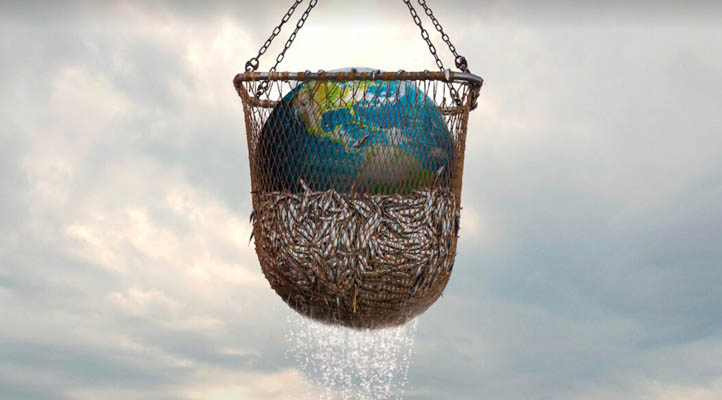
The controversial new Netflix documentary, Seaspiracy, takes viewers on filmmaker Ali Tabrizi’s quest to understand the harm being done to our oceans, and what the real causes of this damage are.
Commercial fishing: The greatest threat to the world’s oceans
Tabrizi starts off by looking into some of the most common issues that come to mind when we think about harm to sea life: the massive amount of plastic being dumped into the oceans, the dolphin and whale hunting that takes place in Japan, and the shark finning industry.
Large aquatic animals like whales, dolphins, and sharks are crucial to the health of our oceans and to our climate. Whales, in particular, fight global warming not only by absorbing CO2 from the atmosphere directly, but also by creating the conditions in which microscopic phytoplankton thrive. These phytoplankton are essential to all life on Earth, as they contribute at least 50 percent of all oxygen to our atmosphere and capture an estimated 40 percent of all CO2 produced. This is what makes oceans the biggest carbon sinks on Earth. Thus, when it comes to limiting the harmful effects of greenhouse gas emissions, maintaining the integrity of our oceans is even more important than planting trees.
Tabrizi quickly learns that the greatest threat to marine life is, in fact, commercial fishing. Yet, seafood consumption is an issue the biggest environmental and ocean conservation organizations are conspicuously silent about. For example, we have all heard about the damage done by plastic straws in the oceans; these sadly kill approximately 1,000 sea turtles per year. But the World Wildlife Foundation has estimated that 250,000 sea turtles are killed every year by fishing vessels. Even campaigns against ocean plastic fail to mention that a significant amount of plastic in the ocean comes from abandoned fishing nets and other fishing gear. The film notes that plastic straws are estimated to make up 0.03% of ocean plastic, while fishing gear is estimated to comprise 46% of the Great Pacific Garbage Patch.
One of the greatest culprits of ocean damage is the practice of bottom trawling, which involves dragging massive fishing nets along the ocean floor, destroying massive areas of sea habitat in order to catch as many fish at one time as possible. For context, 25 million acres of land are deforested every year, while ocean trawling wipes out an enormous 3.9 billion acres of seabed per year. Of course, fishing nets do not discriminate between fish and other non-targeted sea life – including cetaceans, sea turtles, and seabirds, among many others – referred to as “bycatch”.
All of this leads Tabrizi to conclude that eating seafood is just as bad, if not worse, than practices like shark finning which are typically viewed as more egregious.
Is large-scale sustainable fishing possible?
Tabrizi finds that ocean conservation organizations are recommending that consumers choose “sustainable seafood” as a way of helping the oceans. But what does this mean? As it turns out, there is no universally accepted definition, and even if there were, commercial fishing is notoriously difficult to regulate to ensure any standards are being met. Unfortunately, “sustainable” and other consumer labels such as “dolphin safe” and the MSC “blue tick” are often little more than marketing tools that may make consumers more comfortable continuing to eat seafood, while the actual benefits to ocean life are questionable.
It was once thought that fish farming could offer a solution to the harms of commercial fishing, but it turns out that fish farming still relies to a large extent on commercial fishing for its inputs, i.e. fish feed, and comes with its own set of problems including the proliferation of marine parasites and diseases, and organic waste pollution, not to mention the cruelty to the fish being farmed.
It must be understood that humans are extracting sea life from the oceans on an unprecedented scale, and our demand for seafood is expected to continue rising. While there may be better and worse ways of doing this, it is difficult to understand how we could ever hope to maintain our current level of consumption, let alone increase it, without continuing to cause irreparable damage to our oceans.
Is sustainability even the right goal?
Viewed in isolation, certain local, small-scale fishing operations could be considered sustainable in the sense that they could continue indefinitely. For example, towards the end of the film, Tabrizi visits the Faroe Islands to observe the whale hunt that takes place there. Because only a very small proportion of the overall whale population is killed, many consider it to be a sustainable practice. However, in an emotional scene, Tabrizi watches up close as a group of whales is surrounded by boats and driven into a small inlet where the hunters await them. The hunters kill the whales by stabbing them with knives and then cut open their necks, turning the water in the inlet blood red. This leads Tabrizi to question whether sustainability is really the right goal for us if we wish to take care of the oceans: “Sustainability just means that something can continue on and on forever, regardless of how much suffering it causes.”
The film goes on to consider the sentience of fish, who have excellent vision, hearing, sense of smell, touch, and taste, and pain receptors that allow them to feel physical, chemical, and heat types of pain – the same types of pain humans feel. There is evidence that fish experience curiosity, concern, and fear, and that they participate in complex social structures and communication. In light of this, even if we could continue eating them “sustainably” (which is extremely doubtful), the question remains: is this the right thing to do?
A better solution: plant-based eating
Finally, Seaspiracy notes that eating fish is unnecessary for human health and can in fact be harmful due to the bioaccumulation of contaminants such as mercury and PCBs. Despite a common misconception, fish do not actually make omega-3 fatty acids. Rather, the omega-3 fatty acids originate in algae prior to being eaten by fish. Thus, humans do not need to consume fish in order to get our omega-3s. When interviewed, Dominique Barnes of New Wave Foods put it this way: “Plant based solutions are definitely one of the best options that we have to go forward … If we can find alternatives that are just as delicious, just as healthy for you, but better for the environment, why wouldn’t we do it?”
The film ends on a hopeful note with the filmmaker concluding that after everything he learned: “The single best thing I could do every single day to protect the ocean and the marine life I loved was to simply not eat them.” Despite the bleak situation our oceans currently face, it appears that marine recovery is possible – if humans leave our amazing ocean ecosystems alone and consume plant-based foods instead.
We highly recommend that you watch Seaspiracy to learn more.*
* While the information presented in the film is comprehensive and accurate overall, we note that certain claims cited in the film are doubtful. In particular, an outdated study claiming that if current fishing trends continue, “the oceans will be empty by 2048” should not be relied upon. However, on this point, the comments of Professor Callum Roberts, a marine conservationist at the University of Exeter, are apt:
My colleagues may rue the statistics, but the basic thrust of it is we are doing a huge amount of damage to the ocean and that’s true. At some point you run out. Whether it’s 2048 or 2079, the question is: ‘Is the trajectory in the wrong direction or the right direction?’