
• Why Plant-Based?
    • Overview
    • Sustainability
    • Better health
    • Compassion for animals
  • Resources
    • Virtual speaker series
    • Speakers program
    • Pamphlets
    • Newsletters
  • Blog
  • About Us
    • Who we are
    • Contact us
  • How to Help
    • Join us
    • Donate
  • Subscribe to Newsletter
Earthsave CanadaEarthsave Canada
  • Why Plant-Based?
    • Overview
    • Sustainability
    • Better health
    • Compassion for animals
  • Resources
    • Virtual speaker series
    • Speakers program
    • Pamphlets
    • Newsletters
  • Blog
  • About Us
    • Who we are
    • Contact us
  • How to Help
    • Join us
    • Donate
  • Subscribe to Newsletter

Trying to stop climate change? Eating plant-based is more helpful than eating local

Trying to stop climate change? Eating plant-based is more helpful than eating local

Trying to stop climate change? Eating plant-based is more helpful than eating local

May 18, 2020 Posted by Guest Author

By Carmen Ang

Across the globe, people have become increasingly concerned about climate change and how to reduce greenhouse gas emissions. 

If you google “ways to reduce your carbon footprint,” you’ll likely find several sources that recommend a “locavore” diet, or in other words, the purchasing and consumption of locally produced food. Even organizations like the United Nations have publicly supported this idea — in October 2019, they shared a tweet encouraging their followers to take climate action, and listed buying local and organic food as a way to do this. 

While the “locavore” diet certainly has its benefits, it doesn’t have as big of an impact on your carbon footprint as you may think. But before we dive into the reasons why, it’s important to understand the context behind this widely held misconception. 

In our globalized world, importing and exporting food is a big business. Modern technology and advancements in infrastructure have made shipping food easier than ever, and international trade agreements have lowered tariffs on imports. While a globalized food system is convenient and cost-effective, food is now being transported over long distances, upping a product’s “food miles,” or the total distance food travels from farm to table. Since the vehicles used to transport these goods emit carbon dioxide into the atmosphere, it is thought that the higher a product’s “food miles,” the bigger its carbon footprint.

Which, in theory, makes a lot of sense. Yet, according to recent data released by Our World in Data, transportation makes up a relatively small amount of the total greenhouse gas emissions generated by food.

The graph below is a visualization of data from the largest meta-analysis of global food systems to date, published in Science by Joseph Poore and Thomas Nemecek in 2018. 

It shows the total emissions from 29 different food products, providing a breakdown of each stage in the supply chain, along with how much that stage contributes to the product’s total emissions.
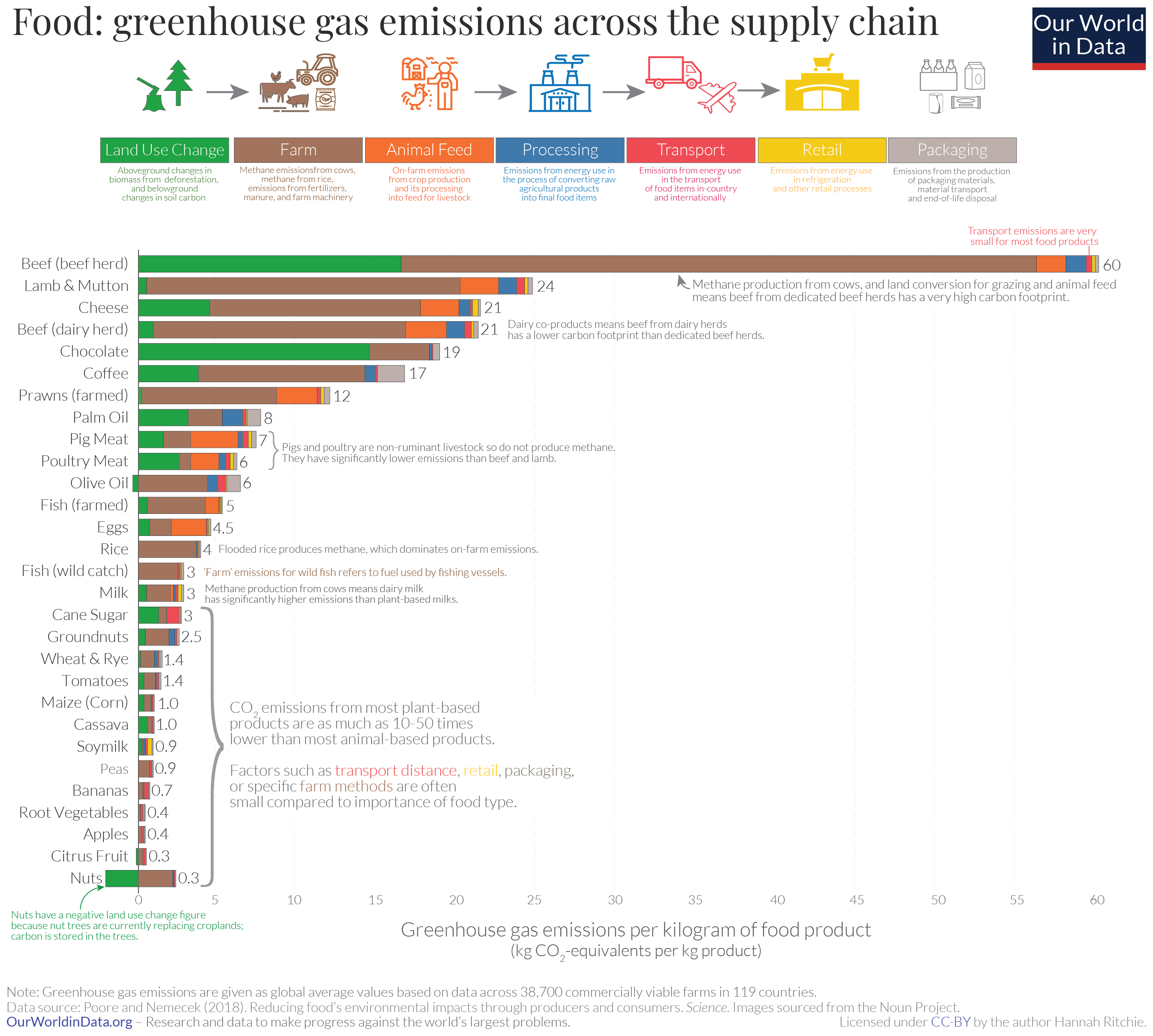
The data reveal that “transport is a small contributor to emissions. For most food products, it accounts for less than 10%, and it’s much smaller for the largest GHG emitters. In beef from beef herds, it’s 0.5%.”

Rather than transport, most greenhouse gas emissions come from land use change and farming, and animal-based foods tend to have a higher footprint than plant-based foods. For instance, the methane, land conversion and feed needed for raising beef has a massive carbon footprint, whereas nuts have a small carbon footprint because trees store carbon, canceling out most of the emissions generated during production.

Therefore, if you’re looking to lower your carbon footprint through your food choices, limiting your consumption of meat or choosing a plant-based diet has a much greater impact on the climate than buying locally produced food.

Of course, the local food movement is not without its merits. Purchasing food that is produced locally is a good way to support local farmers, promote community business, and contribute to your local economy. Local farms are typically organic, and are less likely to be sprayed with harsh pesticides, so choosing locally produced food can be a healthier, more natural option.

While eating locally sourced food is still beneficial to the community, it’s important to remember that you aren’t significantly lowering your carbon footprint, or helping out the climate, without reducing or cutting out animal-based products from your diet. 

It’s not so much about where your food comes from – it’s about what your food is.


Graphic by Hannah Ritchie
Photo by Elviss Railijs Bitāns from Pexels

Share

About Guest Author

Guest authors contribute to Earthsave Canada, but are not members of the board.

You also might be interested in

2023 in review: Plant-based movement offers hope in the face of bleak environmental outlook

2023 in review: Plant-based movement offers hope in the face of bleak environmental outlook

Jan 4, 2024

Even as 2023 saw record-breaking global temperatures, global efforts to tackle the climate crisis have largely failed to acknowledge the need to transition our food system to more sustainable, compassionate and healthy plant based diets. However, there has been some positive progress. This blog recaps some of the year’s significant events, with links to many of our blog posts from 2023.

COVID-19: A disaster of our own making

COVID-19: A disaster of our own making

Apr 8, 2020

The relationship between animal consumption and human illness is well established. The widespread adoption of a plant-based (vegan) diet could protect us against future pandemics.

Meat just doesn’t cut it in today’s environment

Meat just doesn’t cut it in today’s environment

Jun 11, 2017

Humans may have evolved as omnivores, but insisting on eating meat today may threaten our very survival.

Donate

Recent Posts

  • United Nations Environment Program: The World is In Grave Danger – But We Can Save It … and Thrive!
  • 2025 State of the Climate Report: A dire reality that we CAN turn around!
  • COP 30: The impacts of animal agriculture on the climate
  • Meat industry influence may lead to biased conclusions in nutrition studies

Follow us

Engage with us on facebook

Earthsave Canada

12 hours 23 minutes ago

:( :( :(

"Birds [who] spent more time at tourist sites were markedly more likely to die, while faster, farther-ranging birds lasted longer."

Ravens that take risks around humans are less likely to survive

A new study shows that fan-tailed ravens living near the Dead Sea are more likely to die when they spend time around humans.

2
View on Facebook
Share

Earthsave Canada

14 hours 31 minutes ago

"o bring some awareness to the state of our planet and its inhabitants, Joan Chan, a comic artist from Hong Kong, started a comic series

Artist Illustrates The Sad Reality Of Animal Cruelty And Shows How Factory Farming Harms Our Planet

Our ocean, land, and the array of species that call it home are succumbing to the poison of plastic. According to the United Nations, at least 800 species worldwide are affected by marine and land debris, and as much as 80 percent of that litter is plastic. It is estimated that up to 13 million metr

1
View on Facebook
Share

Earthsave Canada

17 hours 9 minutes ago

Biofuels, like animal agriculture, are utter insanity on any large scale. "Cheap biofuels are an illusion; someone, somewhere is paying the price through higher food

Why shipping’s cheapest alternative fuel could become its most expensive mistake

Cheap biofuels are an illusion: someone, somewhere is paying the price through higher food prices, deforested lands and disruptive climate impacts, writes Bryan Comer

View on Facebook
Share

© 2026 · Earthsave Canada.