This Thanksgiving Day, perhaps we should consider just what it is that we are thankful for and how we can make sure that those generations who follow us will be thankful, too. Because, the fact is, if we keep on living the way we are, it won’t be long before there will be very little to be thankful about. Perhaps we can begin by listening to the experts.
Over 30 years ago, the Union of Concerned Scientists issued its Warning To Humanity, stating that “Human beings and the natural world are on a collision course… No more than one or a few decades remain before the chance to avert the threats we now confront will be lost and the prospects for humanity immeasurably diminished”. The warning was signed by over 1670 scientists, including 104 Nobel laureates. Many similarly dire warnings have followed since, summarized here, on the 30th anniversary of that warning.
Incredibly, we have yet to respond in any way remotely proportional to the crisis we face. Instead, we’ve allowed the situation to get worse. We in the wealthy demographics of the Global North are consuming more, polluting more, and ignoring more than even then.
I recently came across the Earth Overshoot website, and was shocked to learn that extending the average Canadian’s lifestyle to all of humanity would require more than 5 Earths! Even maintaining it on just one Earth over the long term is going to be impossible. Without substantial, truly major change, this world will become a living hell for the vast majority of those who inhabit it. And, as it stands, our collective mindsets virtually guarantee disaster.
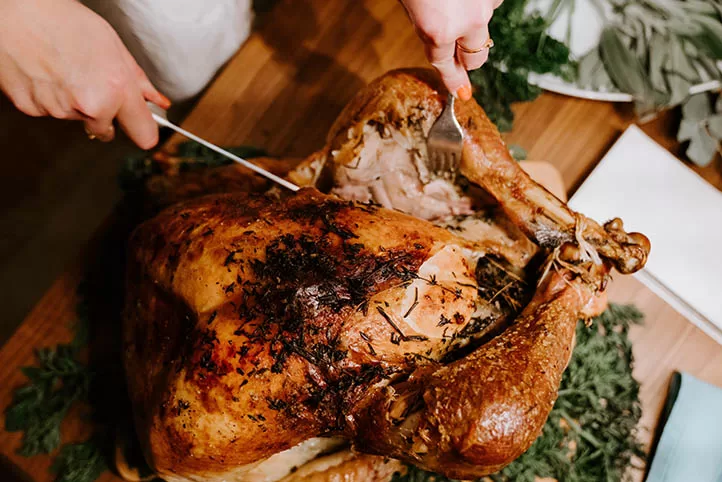
It is all too common for us to act without giving much thought to the impacts our choices have on the planet and the other beings we share it with. Consider the traditional Thanksgiving turkey meal. The carcass is sliced up without the slightest thought about where “it” came from. Mere days or weeks before that turkey appeared on the table she was a living, breathing, sentient being. Almost certainly, she led a hellish life. Because of selective breeding, she grew unnaturally large unnaturally fast. She had no room to move. Her beak was mutilated – the end cut off – and her toes were clipped.
Near the end of her life, she was manhandled onto an even more overcrowded truck and brought to a slaughter house. There, fully conscious, she was hung upside-down by her feet on a moving rail. Her head was dragged through an electrified tank, where she may or may not have been rendered unconscious. If she was one of the “lucky” majority, her throat was then cut by a mechanical knife and she bled to death. However, if she remained conscious past the electrified tank she may have managed to avoid the knife and continued alive and absolutely terrified down the line. She then followed her “luckier” companions to the scalding tank where she was dunked, whole body, in boiling water and scalded to death. It was from there that she made it to the table.
Think about it. It is the social norm in this country to ignore incredible cruelty just for individuals to “enjoy” a very minor luxury. Raising beings like this does not align well with the values of giving thanks. Our Thanksgiving holiday is rooted in Indigenous values of gratitude. Prior to colonization, Indigenous peoples expressed celebrations of thanksgiving, displaying respect, care, and reciprocity for and with the Earth. Reciprocity with the Earth is largely absent from the ways the vast majority of us in this country currently live.
The good news is that we each have the opportunity to reflect on our decisions today, and that working towards a sustainable way of living is not yet out of sight. Living a sustainable lifestyle can be a very rewarding experience, indeed. The bad news is that, if we don’t begin to change – all of us – our prospects are very, very bleak.
This Thanksgiving, let’s resolve to think about what we’re doing. Let’s resolve to do our very best to do no harm. And let’s start by leaving the turkey (and all other animal products) off of our plates. Let’s choose foods that do not inflict harm on others.
Photo by Claudio Schwarz on Unsplash