The importance of biodiversity
Central to the Great Law of the Haudenosaunee Confederation (aka the Iroquois Six-Nations) is the principle that, in every deliberation, the impact of the decisions on the next seven generations must be considered. One of those fundamental deliberations – so very important today – is ‘what shall we eat?’. A principle like theirs is one we are in desperate need to adopt.
Since the infancy of agriculture some 10,000 years ago, we have changed the face of the planet. Today, fully half of the world’s habitable land is occupied by agriculture; over three quarters of that is devoted to animal agriculture. Vast monocultures of corn and soy are integral to the latter.
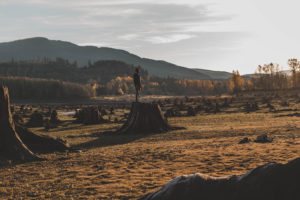
All ecosystems, in order to be healthy and resilient, require biodiversity. But animal agriculture and, especially, the huge grain monocrops used to supply it have massively decreased that essential diversity. Meadows that once supported countless interdependent species have been transformed into row upon row of sameness. Native species of plants and animals have been locked out.
We humans evolved to require a wide variety of foods to maintain good health. But today, over half of our calories come from just four crops – corn, soy, wheat and rice. Most of that corn and soy is not even directly eaten by us. It is funneled through farmed animals. This is outrageously inefficient. When we eat animal products we are effectively throwing away some 80 to 90% of the protein and calories that we could have consumed had we directly eaten plants as food instead.
Our overuse of corn and other crops in animal agriculture
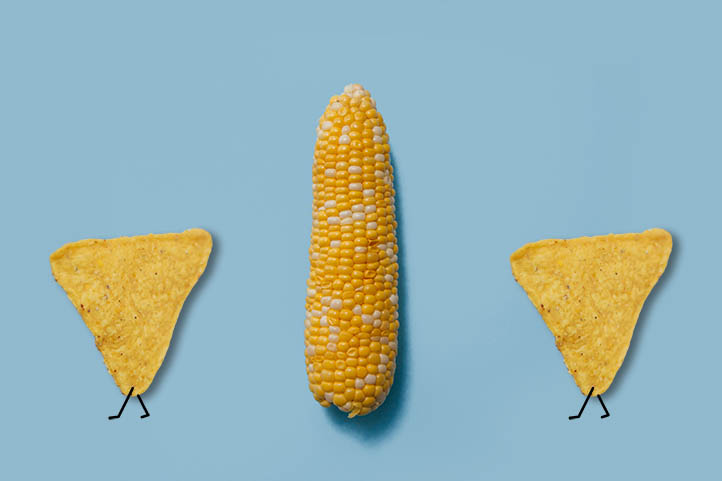
Descendants of the Maya living in Mexico refer to themselves as “the corn people” because of their nine thousand-year reliance on corn as a food staple. But it is we who look like “corn chips walking according to modern scientific analyses of carbon isotopes in the bodies of North Americans.”
The reason is that while it looks like we’re eating a wide variety of foods, corn is actually hiding almost everywhere we look. Soda pop, ketchup, salad dressing and cookies are commonly made with corn syrup. Ditto for many yogurts, protein bars, soups and more. Most of all, the reason is that corn is the major component in farmed animal feed.
Thus, it’s not surprising that, effectively, vegans and others on plant-based diets eat far less corn than a typical meat-eater. Consider for example that, depending on how long the cattle are kept on the feed lot, it takes some 8 – 16 pounds of dry corn and soy to produce a single pound of beef. This overuse of corn (and soy) as feed crops has been devastating on many levels – on human health, on the environment and on billions upon billions of innocent farmed animals.
Cows evolved as ruminants, to digest grass. Eating grain and soy creates environments in their guts where toxic bacteria can grow. The E. coli that has killed so many people and ruined the kidneys of many more doesn’t do well in a grass fed cow. It thrives, though, in a grain fed gut. From there, that E. coli also gets onto any crops on which cows’ manure is spread on the soil.
Even worse for human health, the crowded, unnatural conditions on feedlots and other “modern” animal farms are ideal for disease to run rampant. To avoid this, farmers spike the feed with antibiotics. Indeed, the great majority of antibiotics – by weight! – used in North America are fed to farmed animals. This practice is without a doubt a major player in the development of antibiotic-resistant super-bugs, a very real danger to humanity.
Other environmental and health effects of animal agriculture
The environmental effects of animal farming are equally troubling, with water pollution being one of the most serious. Corn monocropping, especially, uses large amounts of fertilizer, much of which runs into our rivers, lakes and oceans where it causes algal blooms. These algae are short lived and, once dead, their decomposition consumes essentially all of the oxygen in the waters. The fish, lobsters and other life in those waters suffocate. Gigantic “dead zones” are the result. At the mouth of the Mississippi last fall, 5334 square miles of the Gulf of Mexico was dead because of this.
The enormous quantities of manure emanating from concentrated animal farm operations also cause other forms of deadly, severe water pollution – think Walkerton, Ontario. And animal agriculture, by its very nature, makes us prone to water shortages. Producing animal protein takes roughly 100 times more water than producing vegetable protein, according to the meticulous research of Cornell University’s David Pimentel.
Nearly all modern agriculture is associated, also, with serious soil loss. Again, animal agriculture is the biggest offender. Much of this loss results from overgrazing, but the majority is, again, related to the crops we feed to farmed animals. We feed most of our corn to farmed animals and corn is one of the worst contributors to soil loss. The soy we grow to feed the animals is not much better. It wouldn’t be so bad if we were eating the plants directly – we’d need so much less of these crops – but we’re mostly not eating them directly. Ending animal agriculture would go a long way towards preserving the fertility of our lands.
And of course, animal agriculture is an enormous contributor to global warming – responsible for more greenhouse gas effect than all of transportation combined. Shifting to a diet of plant-based food has more power to reduce global warming than just about anything else we can do as individuals. In addition to directly reducing GHG emissions, widespread adoption of vegan diets would allow the return of most agricultural land to nature, leading to the actual removal of carbon from the atmosphere and reseeding so much of the biodiversity that we have lost.
The David Suzuki Foundation has emphasized the need to move to low-impact sources of dietary protein. This need not result in eating less protein – although, that would not be a bad thing in our society, considering that Canadians consume, on average, an unhealthy double the recommended amount of protein. Plants contain every essential amino acid in abundance. Scientists have known for decades that it is unnecessary to deliberately combine the amino acids taken in through plant foods. Any reasonably varied vegan diet will provide ample complete protein.
Out of the many classes of protein-rich crops, legumes are especially easy to grow and, if rotated, good for the soil. But, you might say growing soybeans to feed livestock is a main reason that much of the Amazon rainforest has come to be – and is still being – destroyed. We could save the rainforest and still be overflowing with the beans grown there simply by eating them directly. At the moment, we’re vastly diminishing their ability to feed humanity by funneling those beans through cattle, pigs and other animals.
Clearly, a wholesale move to plant-based diets would do wonders for our health and for the ecosphere.
Abuses inherent in animal agriculture
Such a dietary shift would also save billions of unprotected farmed animals from horrific abuses. Of laying hens, ninety-eight percent are forced to spend their entire lives crammed together in tiny battery cages. Female pigs are kept immobile in tiny ‘gestation crates’, litter after litter, while their young nurse through bars designed to keep them away from their mothers. Dairy calves are stolen from their mothers at just a day or two old and either kept (if male) in tiny cages themselves until they are old enough to be killed for veal or, if female, condemned to the same cruel fate as their mothers.
We are in no way compelled to support this rampant abuse of other sentient beings by spending our dollars on animal products. Many of the routine practices on animal farms would be punishable by law if they were inflicted upon dogs or cats, who are like farmed animals in their intelligence, sociability and capacity to experience pain and pleasure. All of them are non-human persons.
In his 1953 Nobel Peace Prize address Albert Schweitzer urged us not to exclude non-human persons: “The human spirit is not dead. It lives on in secret…. It has come to believe that compassion, in which all ethics must take root, can only attain its full breadth and depth if it embraces all living creatures and does not limit itself to mankind.” Isn’t it time that we listened?
It is time for us all to recognize the realities of animal agriculture and to act appropriately in their light. It is time to move away from eating animal products.
It is time for us all to eat well.
Photo derived from one by charlesdeluvio on Unsplash