
Veganism is growing in popularity, but it certainly isn’t a new concept! I got curious recently — when did it begin? I did a bit of a deep dive on the internet, and decided to dedicate this blog post to some of my findings.
Veganism traces back to ancient times
Although the term “veganism” wasn’t used until the 1940s, the concept can be traced back to ancient Indian and eastern Mediterranean societies.1 According to The Vegan Society, evidence of people choosing to avoid the consumption and use of animal products can be traced back over 2,000 years. As early as 500 BCE, Greek philosopher and mathematician Pythagoras and his many followers practiced vegetarianism for several reasons, mainly religious and ethical.2 Fortunately, modern vegans haven’t adopted everything from the Pythagorean school of thought, such as the Pythagorean rejection of the consumption of beans (or even touching beans!) because they thought beans were made of the same material as humans.2
Around the same time, Siddhārtha Gautama (better known as the Buddha) was also discussing vegetarian diets with his followers.3 In addition, followers of Hinduism and Jainism also advocated vegetarianism, promoting the belief that humans should not inflict pain on other animals.2
Dr. William Lambe — a vegan in the 1800s
My reason for objecting to every species of matter to be used as food, except the direct produce of the earth – as maybe seen in my last publication – is founded on the broad ground that no other matter is suited to the organs of man. This applies then with the same force to eggs, milk, cheese, and fish, as to flesh meat.
Dr. Lambe
In 1806, at the age of 41, Dr. William Lambe adopted an exclusively plant-based diet as a result of health problems. At the time, it was common for people following a “vegetable diet” to consume dairy products, but Dr. Lambe rejected these products as well, making him one of the first “vegans” as we know it today.4 Dr. Lambe wrote many works throughout his life, but notably some related to the health impacts of his own vegan diet as well as that of others in a few case studies.
The only known biography of Dr. Lambe was written in 1873 by Edward Hare. Little is known about Mr. Hare, although we do know that by 1891 he had become a Vice President of the Vegetarian Society. Based on expressions of his own views in the biography he wrote, it is clear he shared Dr. Lambe’s view of what we now call a “vegan” diet.
Dr. Lambe’s books were widely read in Europe and in North America. In 1883, Howard Williams wrote the book Ethics of Diet, which is the highly influential, first book on the history of vegetarianism and includes substantial quotes from Mr. Hare’s biography of William Lambe.4
There were many other vegans during the 19th and early 20th centuries. For example, Asenath Nicholson (1792-1855) operated a vegan boarding house in New York City.5 Louisa May Alcott, famous for writing the classic novel Little Women, was raised vegetarian, and was an abolitionist and a feminist.5 Caroline Earl White founded the first animal shelter in the USA, and is known as the “mother of animal rights advocacy” in the United States.5 I encourage you to read more about these vegan women and others on this website: http://veganfeministnetwork.com/vegan-feminist-history/.
Modern day vegans
The Vegan Society website provides fascinating information about modern vegans. In November 1944, a British woodworker named Donald Watson and his wife Dorothy6 held a meeting with five other non-dairy vegetarians to discuss their diets and lifestyles. These seven are considered the founders of a new movement. Rather than referring to themselves as “non-dairy vegetarians”, The Vegan Society website notes they considered many labels like “dairyban”, “vitan” and “benevore.” In the end, they adopted “vegan” as the word to refer to their diet and lifestyle
The word “vegan” was chosen as it was formed of the first three and last two letters of “vegetarian”. According to Watson, it marked “the beginning and end of vegetarianism.” In the new Vegan Society newsletter, which had 25 subscribers at the time, Watson issued a formal explanation of the way the word should be pronounced: “Veegan, not Veejan.”1
Although the term was coined in 1944, it wasn’t until as late as 1949 when Leslie J Cross noted the Society had yet to adopt a formal definition of the concept. Cross’ suggestion for a definition was “the principle of the emancipation of animals from exploitation by man.”
The definition of veganism was refined over the years. Since 1988, the official definition has been as follows:
Veganism is a philosophy and way of living which seeks to exclude—as far as is possible and practicable—all forms of exploitation of, and cruelty to, animals for food, clothing or any other purpose; and by extension, promotes the development and use of animal-free alternatives for the benefit of animals, humans and the environment. In dietary terms it denotes the practice of dispensing with all products derived wholly or partly from animals.
The Future of Veganism
Looking back at the history of veganism inspires a lot of hope for the future of the movement. Veganism is becoming more mainstream- one example of this is actor Joaquin Phoenix’s speech at the 2020 Oscars about the harms of the dairy industry.7 People of all ages from around the world are choosing to live vegan lifestyles, for their health, for the planet and for the animals. I encourage you to read the stories of modern day vegan activists, like in this article detailing the perspectives of 10 vegans of color.
[1] https://time.com/3958070/history-of-veganism/
[2] https://www.history.com/news/beans-and-greens-the-history-of-vegetarianism
[3] https://www.vegansociety.com/about-us/history
[4] https://vegsource.com/john-davis/dr-william-lambe—father-of-vegan-nutrition-and-his-vegan-biographer.html
[5] http://veganfeministnetwork.com/vegan-feminist-history/
[6] https://vegnews.com/2010/9/remembering-donald-watson-the-father-of-veganism
[7] https://www.livekindly.co/joaquin-phoenix-dairy-industry-best-actor-oscars-speech/
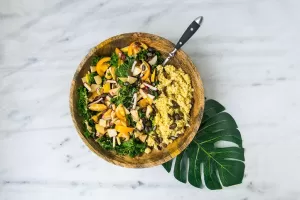
Photo by Andrea Piacquadio from Pexels