

• Why Plant-Based?
    • Overview
    • Sustainability
    • Better health
    • Compassion for animals
  • Resources
    • Virtual speaker series
    • Speakers program
    • Pamphlets
    • Newsletters
  • Blog
  • About Us
    • Who we are
    • Contact us
  • How to Help
    • Join us
    • Donate
  • Subscribe to Newsletter
Earthsave CanadaEarthsave Canada
  • Why Plant-Based?
    • Overview
    • Sustainability
    • Better health
    • Compassion for animals
  • Resources
    • Virtual speaker series
    • Speakers program
    • Pamphlets
    • Newsletters
  • Blog
  • About Us
    • Who we are
    • Contact us
  • How to Help
    • Join us
    • Donate
  • Subscribe to Newsletter

Search Engine online shopping hacks for vegans

Search Engine online shopping hacks for vegans

Search Engine online shopping hacks for vegans

July 21, 2020 Posted by Paige Campbell

Whether you’re a long time vegan or just starting out, finding and ensuring your wares and recipes are animal-free is a frequent part of life. Thankfully, we have this handy thing called the world wide web to help us navigate this lifestyle.

There are many ways to improve your search results to better cater to a vegan lifestyle. Whether you’re looking for food products, recipes, home goods, clothing, or even attractions, by optimizing your search engine results you’ll be able to navigate the web faster and with better precision. Search engines are no stranger to the increase in vegan searches over the last few years. In fact, plant-based was the top dietary trend on google in Canada in 2019. 

Search engines offer the ability to tailor results to vegan searches in several ways. These tips are generally for using Google but can be applied on other websites or even secondhand marketplaces. If you use the Google app on an Android phone, you can specify your ‘feed’ to have vegan-only recipe results using the steps outlined here.

By purposely including or excluding certain terms from your search, you can better cater the results to vegan desires. To include specific terms, put them in the search bar in quotations (e.g. “vegan” pad thai) to ensure that exact phrases are contained within the search results. To exclude specific terms, such as materials that are derived from animals, write the word with a dash before it (e.g. -honey). This will omit results with that term in the search.
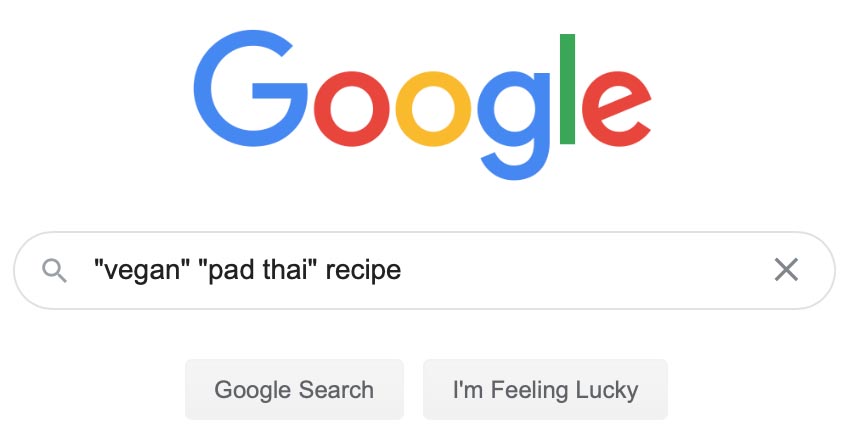
Some examples of popular exclusions for clothes are: -merino, -wool -leather, -cashmere, and -silk . Helpful inclusion examples are “vegan” “synthetic” “faux” and “polyester”. As with food and other purchases, many clothing items that are indeed vegan don’t use that term to describe the product, so by including other words like “synthetic”, you can widen your scope of options while still ensuring no animals were used in the making of that product.

Some searches are especially tricky, as some vegan products use terms paired together such as “synthetic down” or “faux suede,” so keep this in mind when including and excluding phrases from your search terms and adjust accordingly if you’re not getting satisfactory results. If I were looking for a new comforter for example, I’d likely search the following: synthetic duvet -feather -goose.

The same concept of inclusion or exclusion can be applied to recipes, online food shopping, and restaurants. Some popular inclusions for recipes and restaurants include “plant-based” “vegan” “dairy-free” “egg-free” “allergen free”.

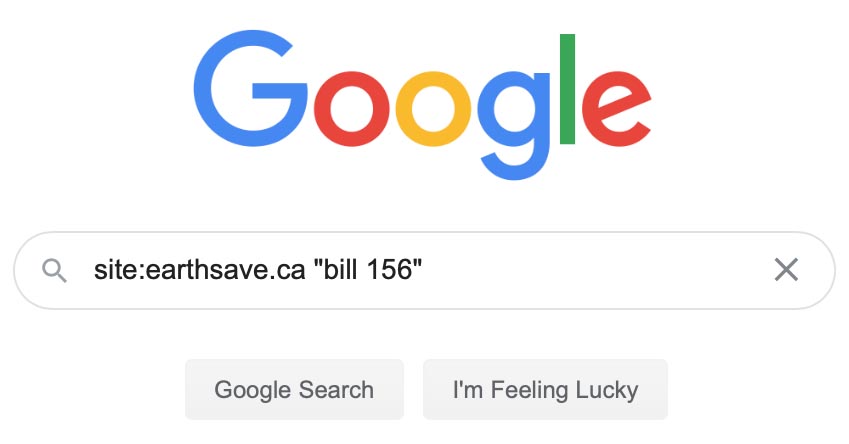
If you want to search only within a certain website, start the search with site:website, as shown below.
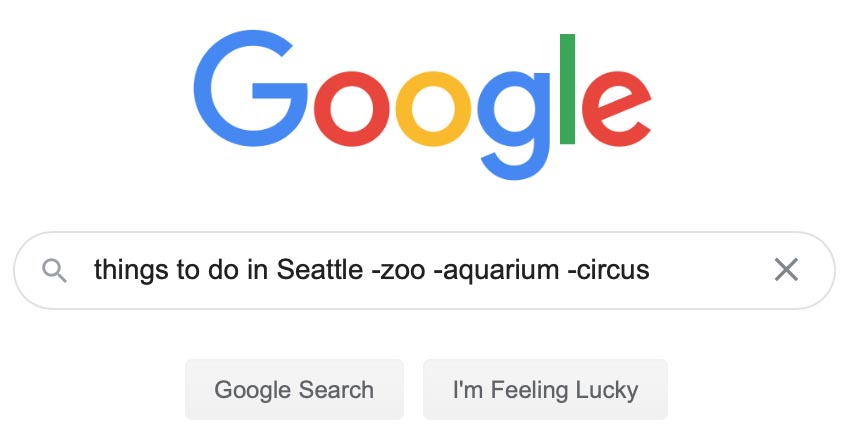
Lastly, these search tips can be especially useful when looking for attractions locally or while travelling to avoid visiting places that exploit animals. Excluding terms like –zoo, -aquarium, -petting -zoo, -farm and -circus can be helpful in this context.
We hope you try out these tips when searching online, and if you find them helpful, consider sharing this blog post so more people can find the vegan goods they’re looking for.


Photo by Andrea Piacquadio from Pexels

Share
Avatar photo

About Paige Campbell

Paige is passionate about improving life on earth for all inhabitants through a biophilic lens. Originally from Ontario, she has an accredited degree in Urban Planning and a Certificate of Sustainability from the University of Alberta. She joined Earthsave in 2019 and works to educate and empower people toward adopting ethical, sustainable, and healthy plant-based eating habits and lifestyle choices. You can catch her cycling in the city, foraging for food, sketching public spaces, playing volleyball, and video blogging wildlife.

You also might be interested in

How to support local vegan businesses while spicing up your time in isolation

How to support local vegan businesses while spicing up your time in isolation

May 8, 2020

Retail sales are down across the country, restaurants being one of the hardest hit industries. This means that it’s more important than ever to be mindful about where and how we’re spending our money - particularly those of us who are fortunate enough to have the resources to do so amidst this time of financial distress for many.

Eating vegan on a budget

Eating vegan on a budget

Mar 31, 2020

As a recent university graduate, there are few things I know better than how to eat vegan on a budget, while still choosing healthy, whole-food options! I thought I’d share some of my go-to tips and tricks about how to eat vegan without breaking the bank.

Vegan burger and fries

Vegan fast food options and alternatives

Apr 12, 2021

I’m admittedly a fan of vegan fast food every now and then, so I wanted to share my thoughts on some of the new vegan options I’ve tried recently.

Donate

Recent Posts

  • 2025 State of the Climate Report: A dire reality that we CAN turn around!
  • COP 30: The impacts of animal agriculture on the climate
  • Meat industry influence may lead to biased conclusions in nutrition studies
  • How can we continue to honour our planet after Earth Month?

Follow us

Engage with us on facebook

Earthsave Canada

8 hours 16 minutes ago

Sadly, when it comes to plant-based foods, none is more damaging than coconut oil. It's even worse than palm oil.

Coconut oil, conservation and the conscientious consumer

Conscientious consumption of agricultural products is hindered by a lack of objective guidance and a distorted public discourse. Meijaard et al. use the environmental impacts of coconut production to illustrate the need for improved measures that facilitate fair and transparent comparisons among pro...

1
View on Facebook
Share
Earthsave Canada

Earthsave Canada

11 hours 1 minute ago

Learn more and view the full slide show at www.instagram.com/p/DVjKkgzlHzn/

1
View on Facebook
Share
Earthsave Canada

Earthsave Canada

13 hours 52 minutes ago

Dairy is based on horrors. "Revelations of cruelty to dairy cows and their babies have emerged in investigation after investigation into dairy farms of all

3
View on Facebook
Share

© 2026 · Earthsave Canada.