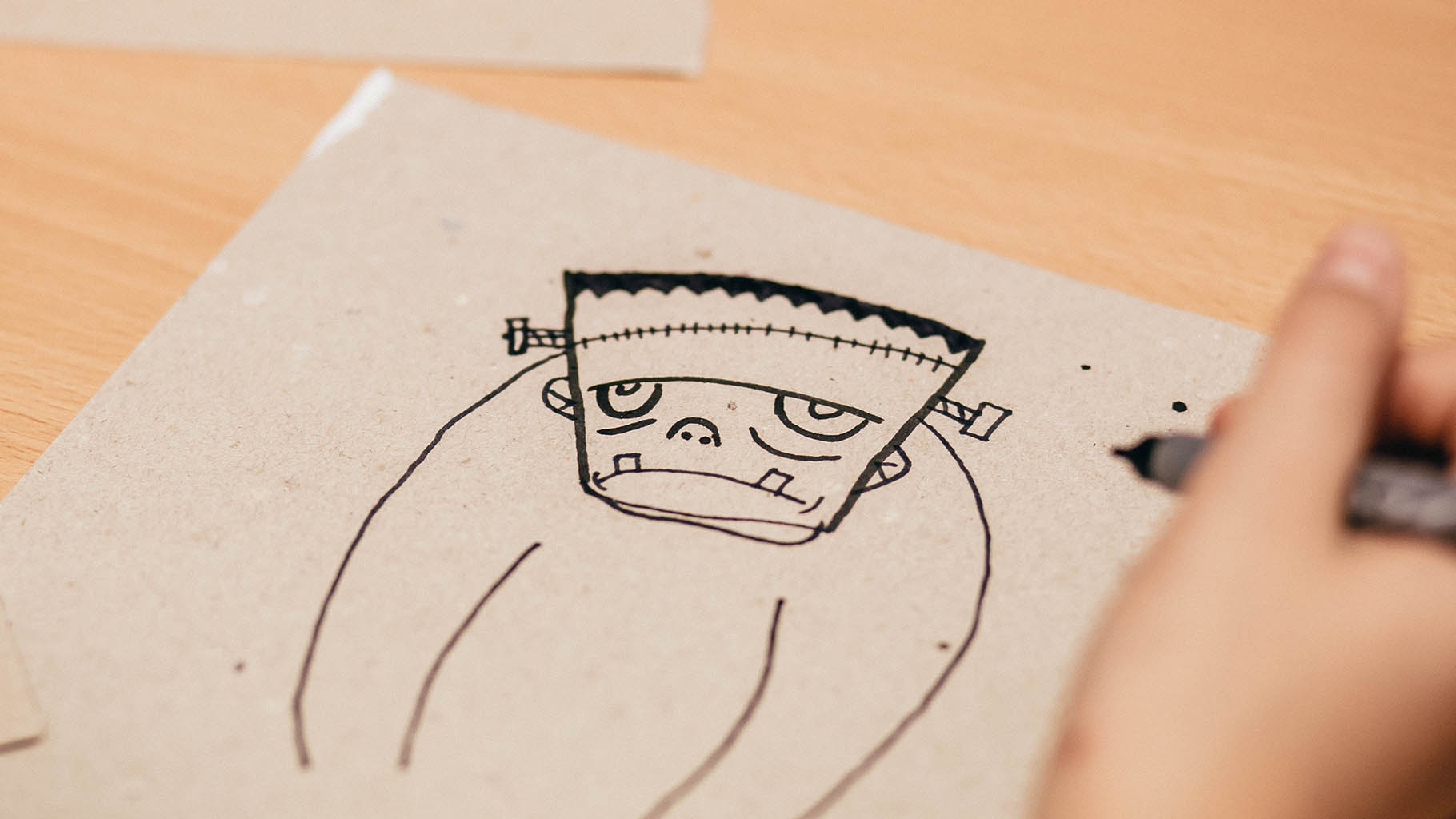
Although Halloween has just passed, this blog tells the story of how the popular Halloween creature from Mary Shelley’s 1818 novel, Frankenstein, is considered to be a vegetarian!
The story starts with a man named Percy Bysshe Shelley, who first experimented with a vegetarian diet while at the University of Oxford, and maintained a vegetarian diet starting in March of 1812 along with his first wife, Harriet Westbrook.1
Percy Bysshe Shelley would go on to write four essays on the subject of vegetarianism, including “A Vindication of the Natural Diet”, published in 1813.2
Shelley had numerous arguments for why he considered eating meat unnatural, including moral, social, ecological and commercial justifications.3 His “A Vindication of the Natural Diet” essay states: “It is only by softening and disguising dead flesh by culinary preparation that it is rendered susceptible of mastication or digestion, and that the sight of its bloody juices and raw horror does not excite intolerable loathing and disgust”.
Shelley wrote that human diseases could be decreased by eating a vegetarian diet.4 This came at a time in history where life expectancy in Britain was very short- an average of 35 years in the 1700s and 41 years by 1820. Zoonotic diseases were common, from contact with animals, inhaling barnyard dust, and consuming undercooked animal flesh. Shelley drew a connection between healthier living and abstaining from a diet containing animals.5
Shelley also wrote about how a vegetarian diet is better for the environment, noting: “the quantity of nutritious vegetable matter, consumed in fattening the carcase of an ox, would afford ten times the sustenance if gathered immediately from the bosom of the earth.”6 It is interesting to see how, despite being so long ago, Shelley touches on many of the modern arguments for a vegan diet.
During the summer of 1816, Percy Bysshe Shelley and his second wife Mary Shelley joined fellow poet (and fellow vegetarian7) Lord Byron and a doctor friend in Lake Geneva, Switzerland. This is the famous origin story of the classic novel Frankenstein. When the weather turned bad, they turned to storytelling to pass the time. Mary Shelley, a few days before her 19th birthday, told a story about a man named Dr. Frankenstein who created a monster.8 This story would later be published in 1818.
Mary Shelley shared her husband’s vegetarian lifestyle. In her novel, Frankenstein’s monster explains his diet to Victor Frankenstein: “My food is not that of man. I do not destroy the lamb and the kid to glut my appetite; acorns and berries afford me sufficient nourishment.”9
Literary critics consider Frankenstein as a work that incorporates many aspects of Mary Shelley’s life and learning. Through her father, William Godwin, Mary Shelley met with many notable vegetarians, including John Frank Newton, author of The Return to Nature.10
Carol J. Adams analyzed Frankenstein’s monster in Chapter 6 of her 1990 book, The Sexual Politics of Meat,11 noting that “[f]or a work that has received an unusual amount of critical attention over the past twenty years, in which almost every aspect of the novel has been closely scrutinized, it is remarkable that the Creature’s vegetarianism has remained outside the sphere of commentary.”
According to Adams’ analysis, the monster’s rejection in the story is very much linked with human treatment of animals: “The Creature includes animals within its moral codes, but is thwarted and deeply frustrated when seeking to be included within the moral codes of humanity. It learns that regardless of its own inclusive moral standards, the human circle is drawn in such a way that both it and the other animals are excluded from it.”12
Vegetarianism was not unique in the Romantic era. Many of the late Romantics argued in favour of a diet which excluded animal flesh for many reasons, including human health, religious beliefs, animal rights and more.13 They saw killing animals as immoral and argued that including animals within the circle of moral consideration was urgently required.14
Next time you hear the story of Frankenstein’s monster, remember its vegetarian roots, and consider- perhaps he isn’t much of a monster after all.
1 https://en.wikipedia.org/wiki/A_Vindication_of_Natural_Diet
2 https://en.wikipedia.org/wiki/A_Vindication_of_Natural_Diet
3 https://www.jstor.org/stable/10.2979/jfolkrese.53.2.01?seq=1
4 https://en.wikipedia.org/wiki/A_Vindication_of_Natural_Diet
5 https://www-jstor-org.ezproxy.library.ubc.ca/stable/pdf/10.2979/jfolkrese.53.2.01.pdf?refreqid=excelsior%3A1029c39997e7c5b838e12d609ffffcde
6 https://en.wikipedia.org/wiki/Vegetarianism_in_the_Romantic_Era
7 https://www.jstor.org/stable/10.2979/jfolkrese.53.2.01?seq=1
8 https://vegsource.com/john-davis/shelley—the-first-celebrity-vegan.html
9 https://en.wikipedia.org/wiki/A_Vindication_of_Natural_Diet
10 https://circodelherreroseries.com/2017/01/22/frankensteins-monster-was-vegetarian/
11 https://www.amazon.ca/dp/B07BFGNH5H/ref=dp_kinw_strp_1
12 http://knarf.english.upenn.edu/Articles/adams.html
13 https://en.wikipedia.org/wiki/Vegetarianism_in_the_Romantic_Era
14 http://knarf.english.upenn.edu/Articles/adams.html
Photo by freestocks on Unsplash