
I recently found myself in an argument about my vegan diet with two young men who told me that they are committed environmentalists. During that discussion, both told me that they were hunters and that they believed that hunting was by far the most sustainable way to eat – more sustainable than vegan diets even, they claimed. One referred me to an article he’d read, The Oil We Eat, by Richard Manning.
I explained why the argument could not possibly hold, but agreed to look for and read the article. I really wanted to do so. I wanted to see how they could possibly have been convinced of such an untenable idea.
Published by Harper’s Magazine in 2004, Manning’s article describes what the author calls the utter insanity of our modern food system. And he makes a very good case that it is so. Indeed, I was pleased to see that he cites the very solid work of an old friend of mine, David Pimentel, as his primary source.
Manning tells us of the many calories of fossil fuel energy that we pour into every calorie of almost all of the foods we eat. Even our fruits and vegetables, conventionally grown, require more calories of fossil fuel energy to produce than we get back in food energy when we eat them. He goes on to explain how the production of meat uses even greater amounts of oil and gas and coal. Ten times as much fossil fuel energy goes into a pound of meat protein as goes into the equivalent from plants, he accurately states. This is mostly because feeding animals for food is so grossly inefficient. As Manning notes, “Eighty percent of the grain the United States produces goes to livestock.”
Clearly, our current food system is not sustainable in the long term. Still, Manning doesn’t quite get it. Ignoring what he had just told us about where the vast majority of Iowa’s crops (corn and soy) are going, he strangely states “On the moral issues, vegetarians claim their habits are kinder to animals, though it is difficult to see how wiping out 99 percent of wildlife’s habitat, as farming has done in Iowa, is a kindness.” Sorry, Mr. Manning! That habitat has been wiped out mostly to feed farmed animals. Eight times more land is required to feed a typical meat eater than to feed a vegetarian.
It is at the end of the article, though, that I found the words that likely most inspired the young men I was arguing with. Manning ends his essay with a romanticized plug for elk hunting. I’ll quote it at length:
“I climbed the mountain behind my house and found a small herd of elk grazing native grasses in the morning sunlight. My respect for these creatures over the years has become great enough that on that morning I did not hesitate but went straight to my job, which was to rack a shell and drop one cow elk, my household’s annual protein supply. I voted with my weapon of choice-an act not all that uncommon in this world, largely, I think, as a result of the way we grow food. I can see why it is catching on. Such a vote has a certain satisfying heft and finality about it. My particular bit of violence, though, is more satisfying, I think, than the rest of the globe’s ordinary political mayhem. I used a rifle to opt out of an insane system. I killed, but then so did you when you bought that package of burger, even when you bought that package of tofu burger. I killed, then the rest of those elk went on, as did the grasses, the birds, the trees, the coyotes, mountain lions, and bugs, the fundamental productivity of an intact natural system, all of it went on.”
It’s an appeal to a sort of personal romantic (anti-)heroism, I’d say. At best, it’s pretty shockingly naive thinking.
I’ll concede that hunting is arguably kinder than factory farming. Almost anything would be! Wild animals often lead harsh lives, but their lives are stimulating and they experience the pleasures of life as nature ‘intended.’ Far better to live free to express one’s basic desires in wide open spaces than to be crammed in tiny, stinking cages, enduring a short, painful, frustrated life. It’s true that our distant ancestors were hunter gatherers and that there are still people in some cultures who even today find it necessary to subsist on that sort of lifestyle. But we are not them.
Imagine what would happen if we collectively became hunters!
To get an idea of just how disastrous such a shift would be, compare the estimates of our continent’s wildlife populations to the numbers of farmed animals ‘raised’ in North America each year. According to US and Canadian government sources, there are some 1 million moose, 72,000 elk and – (mostly in the USA; estimates for Canadian provinces add up to not much more than 1 million) – roughly 35 million deer. Sounds like a lot. But it pales in comparison to the numbers of large animals North Americans eat. In the US alone, over 120 million pigs and 36 million cattle are killed for food each year. Meeting that demand with wild meat would very quickly result in the total decimation of all of the deer, elk and moose who live here.
In terms of large birds, the situation would be even worse. The US Fish and Wildlife Service estimates that our continent supports a wild population of some 39 million ducks and a few million geese and swans. Sound like a lot? Not when you compare it to the over 8 billion chickens and turkeys killed in North America each year. That’s some 200 times as many large birds as live wild on the whole continent!
The bottom line is made very, very clear in a study published in 2018 in the Proceedings of the National Academy of Sciences of the USA. The biomass of the farmed animal population of the world today far exceeds that of all of the wild animals in the world. Farmed mammals now comprise some 60% of the weight of mammalian life on this plant; wild animals make up only 4%; we humans comprise the other 36%. Among birds, 70% of the biomass is in farmed animals; only 30% is in their wild relatives.
Clearly, a switch to hunting to replace meat from farmed animals would be disastrous. The only real solution is a collective movement to veganism.
There’s not the slightest doubt about it. Animal farming is extraordinarily unsustainable and so is hunting. Far from a “dream of innocence” or a “denial of reality,” veganism is the most rational and thoughtful of choices. It confronts reality head on. Done right, it is the only sustainable option.
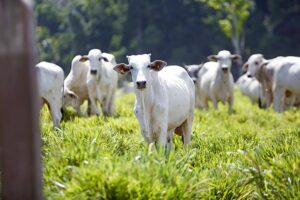
Photo by Paul Einerhand on Unsplash