I’ve always had a problem with our society’s definition of ‘person.’ My Webster’s dictionary defines a person as “a human being, esp. as distinguished from a thing or lower animal.” I think that’s not right. To me, a person is any living being who has wants and desires, who feels emotion, who has a conscious experience of life. That’s why I’m uncomfortable when someone speaks of an animal as something other than a person.
The point, I think, is particularly important when it comes to our treatment of non-human animals who are ‘raised’ on farms. In failing to recognize their personhood, we all too often take license to treat them horrifically.
My first experience with farmed animals was as a kid. We lived in a rural area with 2 acres to our lot. A ways back from the house there was a fence. We’d cross it often on treks to a pond about a mile across the field where we’d find tadpoles and frogs and snapping turtles to gaze at as we picnicked. In winter, we’d take our sleds and ride down the hill that stood above the pond.
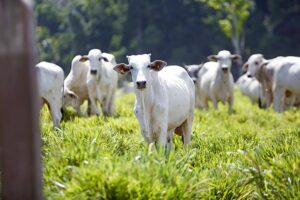
Also on the other side of that fence were a lot of cows. They were very friendly Holsteins, so-called ‘dairy’ cows. If we’d pick grass for them, over they’d come to take it from our hands, slobbering all over us in the process. Even though there was grass galore all around them, they would come over for our offer of exactly the same thing, pre-picked. We loved it almost as much as they did. I developed quite an affection for those cows.
One thing I didn’t notice well at the time was that there were usually no calves around and only a very rare bull. I didn’t think about it. I didn’t understand that the cows were impregnated once a year and that their calves were stolen from them some nine months later, essentially as soon as the calves were born. I didn’t learn about that until a few decades later when I visited a very different sort of farm.
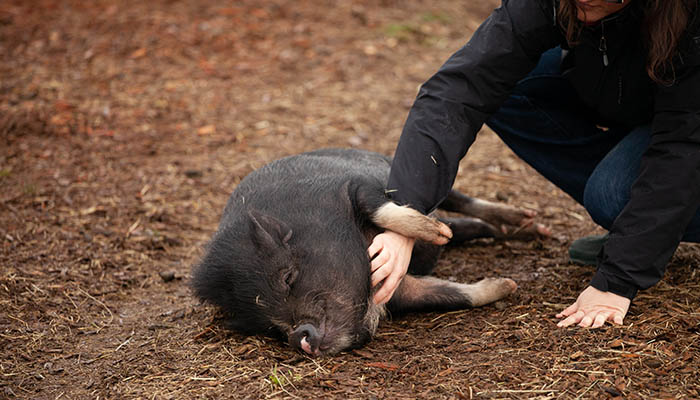
Not far from Ithaca, NY, where I lived in the mid 1990s, is a place called Farm Sanctuary. It’s a 175 acre estate for hundreds of beautiful persons. I visited them then and again a few years later.
Cows and pigs and turkeys and chickens; donkeys, sheep, and goats and more – all lead pleasant lives within its boundaries. I met several of them. The stories of how they got there, though, are heart-wrenching.
Take Hilda, for example, the ewe who started it all. In 1986, Farm Sanctuary founders Gene Baur and Lorri Houston visited a stockyard in Pennsylvania. They were trying to do something good for animals – by documenting some of the abuse that so regularly befalls the creatures most of us think of as only food. Behind one of the buildings, they came upon a terrible sight. Dead animals were piled one on top of the other. Many had been injured in transit and then left to die surrounded by the rotting remains of so many others.
As Gene was photographing the scene, a lone animal lifted her head. She was a young sheep. In the sweltering heat, along with hundreds of her compatriots, she had been packed on a truck and sent to market. During the trip she collapsed, and so was thrown in back of the stockyard to die. Gene and Lorri rescued her and Farm Sanctuary was born.
Among the others I met was Duane. He was a rooster. He was thrown in a trash can the day he hatched. Males born of egg-laying breeds are considered “useless” by the poultry industry. Then there were Kevin and Norman, ‘beef’ cattle abandoned because they were weak and emaciated, and Stephanie, a rabbit who almost died from neglect. I remember the very friendly Billy Martin, a goat who escaped slaughter by bolting from a stockyard in Lancaster, Pennsylvania. Farm Sanctuary was a life-saver for all of them.
In the early days, Farm Sanctuary was a shoestring operation. Gene and Lorri funded it by selling tofu hot dogs at Grateful Dead concerts. Over the years, it has grown tremendously. Now there are two farms – the other one is near Los Angeles in California – with lots of paid staff and volunteers, and a multimillion dollar budget. Every one of the over 1000 animals at their sites gets regular medical check-ups and a nutritious, high-fiber diet. They are loved and they show their love in return.
Today, there are many other farm sanctuaries across North America (and the world!), modeled on the work that Gene and Lorri began. Among the many, many in Canada are Happy Herd, A Home for Hooves, RASTA Sanctuary, and the Happily Ever Esther Sanctuary. There’s even an organization, P.E.A.C.E., that exists to provide crucial help to sanctuaries in need. Please support them and/or pay one a visit. There is undoubtedly one near you.
Sadly, though, the creatures who inhabit these sanctuaries are but a fortunate few. The lives of the literally tens of billions of others are horrific. You can see for yourself by visiting cetfa.org.
To produce veal, calves are chained in two-foot wide crates, their movements severely restricted. Female ‘breeding’ pigs spend their lives in even more confined ‘gestation stalls.’ Breeding sows suffer crippling leg disorders and open wounds because of this treatment.
Chickens and turkeys have part of their beaks cut off to keep them from pecking each other in boredom and frustration. Near the ends of their lives, they all too often hang in horror as their throats are cut; slaughterhouses are not required to reliably stun poultry before the slaughter process begins. Horrific is far too mild a word to describe what we’re doing to farmed animals.
Lorri Houston was absolutely dead-on right when she said,
Farm animals are living, feeling animals; they are not ‘breakfast,’ ‘lunch,’ and ‘dinner’. Americans have drawn an imaginary line and classified some animals as ‘pets’ and some animals as ‘dinner.’ Our society is horrified (and rightly so) when we hear of other cultures eating dogs and cats, and most people would never be intentionally cruel to a dog or cat. I have to hope that they would never be intentionally cruel to a cow or a chicken either. People who love animals called ‘pets’ would not eat animals called ‘dinner’ if they would only look into the eyes of a suffering farm animal.
Farm sanctuaries help us see animals as the persons they are. They change people. Famous physicist Brian Greene, for example, became vegan after visiting the same sanctuary that I did. If you’re not vegan already (and if you are, for that matter), why not visit a sanctuary near you and see for yourself? Please let these sanctuaries help you follow Brian’s lead. It can’t hurt to donate to – or volunteer at – one, either. Indeed, it’ll do a lot of good!
Photo by Ben Mater on Unsplash