

By Carmen Ang
Across the globe, people have become increasingly concerned about climate change and how to reduce greenhouse gas emissions.
If you google “ways to reduce your carbon footprint,” you’ll likely find several sources that recommend a “locavore” diet, or in other words, the purchasing and consumption of locally produced food. Even organizations like the United Nations have publicly supported this idea — in October 2019, they shared a tweet encouraging their followers to take climate action, and listed buying local and organic food as a way to do this.
While the “locavore” diet certainly has its benefits, it doesn’t have as big of an impact on your carbon footprint as you may think. But before we dive into the reasons why, it’s important to understand the context behind this widely held misconception.
In our globalized world, importing and exporting food is a big business. Modern technology and advancements in infrastructure have made shipping food easier than ever, and international trade agreements have lowered tariffs on imports. While a globalized food system is convenient and cost-effective, food is now being transported over long distances, upping a product’s “food miles,” or the total distance food travels from farm to table. Since the vehicles used to transport these goods emit carbon dioxide into the atmosphere, it is thought that the higher a product’s “food miles,” the bigger its carbon footprint.
Which, in theory, makes a lot of sense. Yet, according to recent data released by Our World in Data, transportation makes up a relatively small amount of the total greenhouse gas emissions generated by food.
The graph below is a visualization of data from the largest meta-analysis of global food systems to date, published in Science by Joseph Poore and Thomas Nemecek in 2018.
It shows the total emissions from 29 different food products, providing a breakdown of each stage in the supply chain, along with how much that stage contributes to the product’s total emissions.
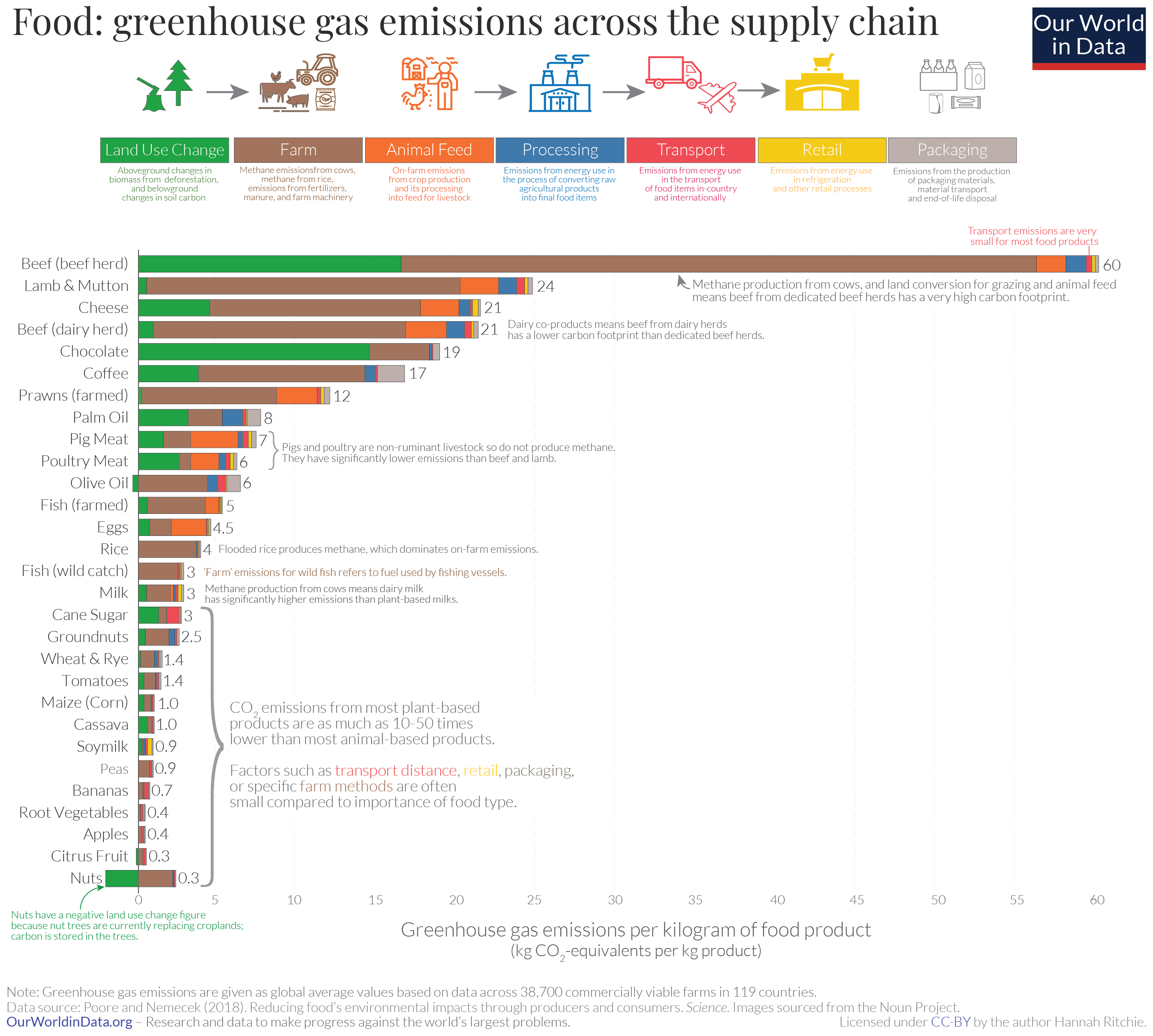
The data reveal that “transport is a small contributor to emissions. For most food products, it accounts for less than 10%, and it’s much smaller for the largest GHG emitters. In beef from beef herds, it’s 0.5%.”
Rather than transport, most greenhouse gas emissions come from land use change and farming, and animal-based foods tend to have a higher footprint than plant-based foods. For instance, the methane, land conversion and feed needed for raising beef has a massive carbon footprint, whereas nuts have a small carbon footprint because trees store carbon, canceling out most of the emissions generated during production.
Therefore, if you’re looking to lower your carbon footprint through your food choices, limiting your consumption of meat or choosing a plant-based diet has a much greater impact on the climate than buying locally produced food.
Of course, the local food movement is not without its merits. Purchasing food that is produced locally is a good way to support local farmers, promote community business, and contribute to your local economy. Local farms are typically organic, and are less likely to be sprayed with harsh pesticides, so choosing locally produced food can be a healthier, more natural option.
While eating locally sourced food is still beneficial to the community, it’s important to remember that you aren’t significantly lowering your carbon footprint, or helping out the climate, without reducing or cutting out animal-based products from your diet.
It’s not so much about where your food comes from – it’s about what your food is.
Graphic by Hannah Ritchie
Photo by Elviss Railijs Bitāns from Pexels