
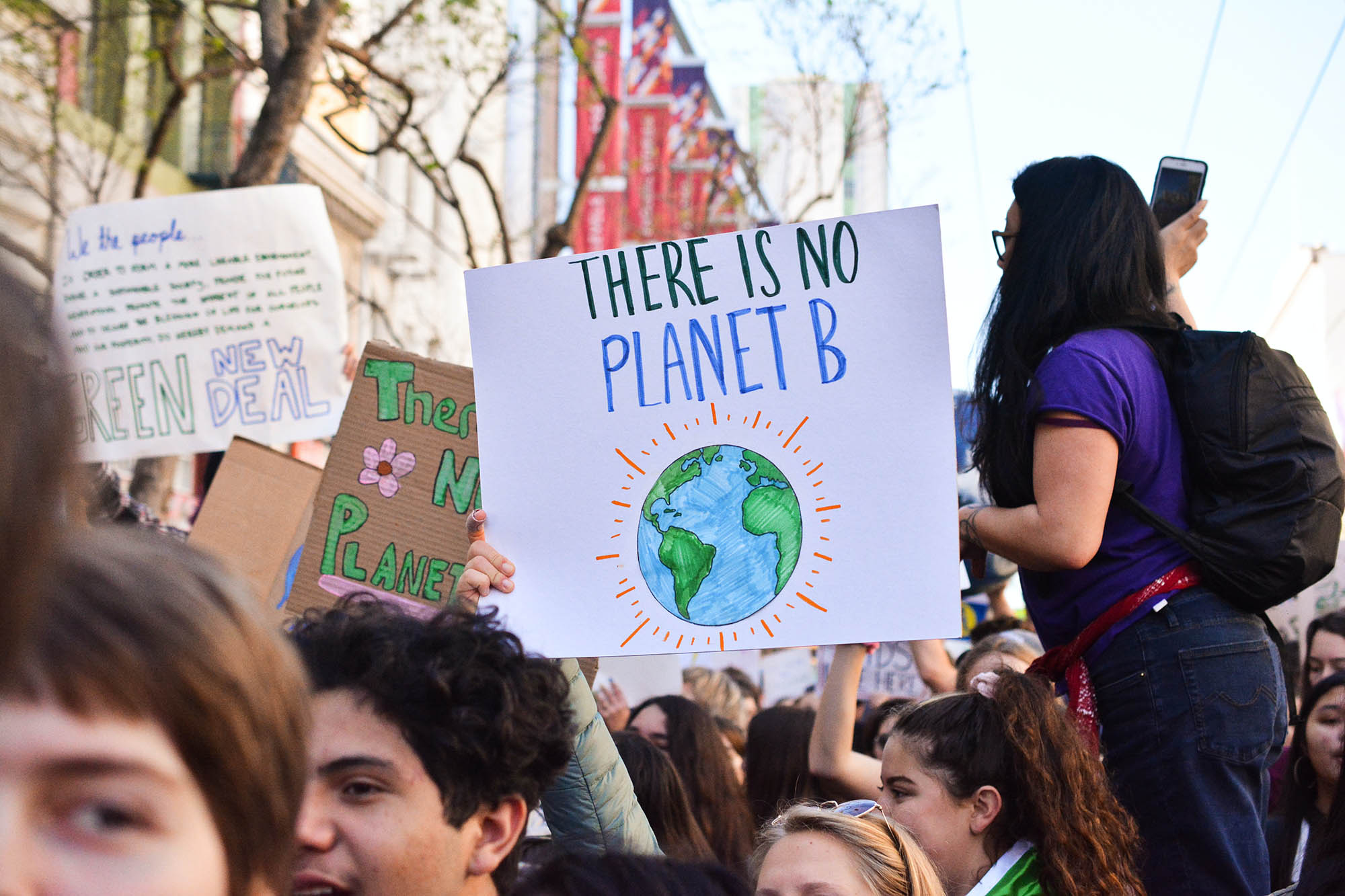
Sometimes you just have to be blunt. Global warming is accelerating and we’re shockingly ill-equipped to stop it. Unless we act powerfully and quickly, we face catastrophe on a scale humanity has never seen.
As you’ve likely heard, the Intergovernmental Panel on Climate Change (a collaboration of hundreds of experts, convened by the UN) released an important report in October of last year. Titled Global Warming of 1.5 °C, it paints a dire scenario of our world just a few decades hence, with wildfires rampant and massive droughts ever more widespread, if we do not very quickly wean ourselves from fossil fuels. In no uncertain terms, these scientists tell us we must hold global warming to no more than 1.5 degrees Celsius above the preindustrial global average. We’re already at 0.8 to 1.2 degrees, they warn us, and the science of the last several years strongly indicates that the former goal of 2 degrees is too dangerous to allow.
It’s not as if we didn’t have plenty of warning. The famous chemist Svante Arrhenius first sounded the alarm way back in 1895. Scientists, tracking the rapid accumulation of carbon dioxide in the atmosphere, have been sounding that alarm ever more loudly since the 1980s. Had we heeded their warnings, we could have made a fairly smooth transition to the society we must become – but we didn’t listen, so here we are.
There is no new science in the IPCC’s report. It is simply a summary of what we already know – and a call to act before it is too late. As the report loudly blares, we’ve only got until 2030 to turn the corner. That’s about eleven years now to completely remake the way we power our lives, slashing our carbon emissions so decisively by 2030 that we’re ready to subtract excess carbon from the atmosphere by 2050 rather add more.
Over those eleven years, coal, oil, tar sands bitumen and even natural gas must fade from the scene. We will have to use them only for the essentials – things like making the fertilizer we need to feed ourselves and the materials, like concrete and steel, we still need as we transition our manufacturing capacity to the likes of wind and solar. We must create efficiencies in every aspect of our lives and economies. Indeed, as the IPCC scientists tell us, we must restructure our societies on a scale that “has no documented historic precedents.”
It sounds scary – perhaps even crazy to some. But there is reason for hope. There are examples of such concerted action elsewhere in the world. Over the last 30 years, for example, European countries have slashed their greenhouse gas (GHG) emissions and now average less than 10 tonnes of CO2 per person per year. China – the world’s greatest GHG emitter – is making a massive move towards powering its society with solar energy. Countries like these are already on the road to where we need to be.
Canada, unfortunately, is not.
Our CO2 emissions have risen dramatically over those same 30 years. Per capita, we are among the worst contributors in the world (by some estimates, actually, the worst) – averaging over 20 tonnes per person. Alberta and Saskatchewan are in a league of their own – over 66 tonnes of CO2 is emitted per person in those provinces each and every year! Per capita emissions in Manitoba are a tad below 17 tonnes. The best we can say is that, of late, our emissions have started to level off.
To put this all in context, the IPCC target for 2030 amounts to roughly 2.8 tonnes per person, 45 percent below the current worldwide average of 5 tonnes. By 2050, GHG emissions must average less than zero. This, says the new IPCC report, is what we must do if we are to limit warmming to no more than 1.5 degrees.
So, what are we going to do? The magnitude of the challenge appears overwhelming.
Yet history provides hope. We have mobilized on an epic scale before. During World War II, allied governments like ours retooled their entire economies to deal with the existential threat of global fascism. They demanded an all-hands-on-deck mobilization of people and resources to maximize the probability of success. The war was horrific, but the threat was stopped. To boot, economies were revitalized; in the aftermath, Canada became a far richer society than it had been before.
We need another World War II scale mobilization. The crisis we face today is unprecedented, but it is of the same ilk. We simply need to rise to the challenge once again; only this time, not with violence, but with constructive world-changing action.
Just look at a few of the consequences, according to the IPCC report, if we don’t limit global warming to 1.5o degrees:
* Sea level will rise dramatically, inundating coastal cities. If we let the warming go to 2 degrees, we can expect an additional 10 cm of sea level rise over the next 80 years.
* Storms, heat waves and droughts of unprecedented strength and duration will become commonplace; our food supplies could collapse as a result.
* Wildfires, already the scourge of our west and of Australia, will become more common and widespread.
* The risk of passing catastrophic tipping points from which we will be unable to recover will increase substantially. For example, triggering the mass release of the potent greenhouse gas methane from melting Arctic permafrost or clathrates (ice deposits) beneath the sea could cause global warming to exceed 6, or 8, or even 10 degrees over the next hundred years.. Tropical regions of our planet could become too hot for humans to survive.
To be candid, the IPCC authors are not optimistic. Jim Skea, co-chair of one of the IPCC working groups, put it this way: “Limiting warming to 1.5°C is possible within the laws of chemistry and physics but doing so would require unprecedented changes.”
Another author of the report, Diana Liverman, confessed: “I am overwhelmed by [the] challenge we face. I had a good cry on [the] plane home from exhaustion and thinking about implications of [the] report.”
But change we must. The alternative is too bleak.
“If action is not taken, it will take the planet into an unprecedented climate future [compared to] all of human evolutionary history,” is how lead author Hans-Otto Pörtner put it to Grist magazine.
There is hope. If we succeed, we’ll be part of a global transformation. Contrast that to the dystopia we face if we don’t. Unlike World War II, we don’t have to kill and destroy. We can transform our world and rebuild for the better. We can create societies that support us well and, in principle, that can be sustained for millennia.
So, just what must we do if we truly care about solving the climate crisis?
First and foremost, each of us must lead by example. We must make it very, very clear that we are serious. We must demonstrate by our words and actions – and to the very best of our abilities – that we are willing to make the personal changes needed to save this world. The world needs role models fast. And politicians need to see that we, the people have their back – that we will elect them if, and only if, they act boldly to end this crisis.
We must set an example. We must abandon our cars to the full extent that we can. The same goes for flying. We must be as energy efficient at home and work as we possibly can – turn down our thermostats and add a thermal layer or two of clothing; use electronics sparingly. We must minimize our purchases of newly manufactured items. And, as the IPCC report also highlights, we must transform the way we eat: we must rapidly move away from eating animal products and very much towards getting our nutrition wholly from plants, which can feed us for a fraction of the carbon footprint. Indeed, almost coincidentally with the IPCC report, a study published in Nature demonstrated that we in the West need to slash our beef consumption by 90 percent – and other animal products to a similar extent – if we’re still going to be able to feed ourselves 30 years from now. Really, if we’re ethical, we’re going to have to end our animal product consumption altogether.
We need to do all of these things. But we also must vote and lobby our governments.
Wow, do we need to lobby our governments! Only they can impose the necessary regulations to make this transformation possible. Only they can provide the carrots, sticks and financial wherewithall for our society to so rapidly change the ways we heat and power our built spaces and run our economies. The unregulated market cannot do it in time. Nowhere close. For example, most of us can’t afford to retrofit our homes, but retrofitted those homes must be. We didn’t leave the transformation of our society to tackle the spread of Nazism to the market, and we can’t leave it to the market now.
Our first-past-the-post electoral system sure doesn’t help. Yet, the fact that a government can be elected based on a little over a third of the vote could be a boon. Enough of us who mean business about climate change could – if mobilized behind an efficient election campaign – turn things around with due haste.
Of course, the same electoral system can be a terrible impediment, as is all too evident in the election of climate change deniers like Doug Ford, Jason Kenney and Donald Trump. A minority of voters can continue to elect people who are anathema to our long-term survival. We who aim to rescue our society from the horrors of global warming must become, at the very least, a bigger minority, whether in numbers, in clout or just by showing up. It’s a bad sign that even modest carbon taxes still meet stiff resistance. We must educate those around us; we must make those taxes, and the necessary transition to renewables, as popular as we possibly can.
Remember, those of us who recognize the imminent threat of climate change are on the right side of history. Our quest is to remake this world so that all can live. The alternative will be a nearly literal hell on earth.
So let’s get to it. Let’s meet. Let’s organize. Let’s reach out to whomever we can and be examples for those around us who do not yet realize just how much is at stake. For we who act as we must are humanity’s last best hope. We must succeed.
Photo by Li-An Lim on Unsplash