On land, at sea, and in the air, the destruction is everywhere
Animal agriculture kills. Massively. It may seem obvious, but most of us have no idea just how murderous it is. In fact, short of thermonuclear war, it is very probably the most destructive activity that humans engage in.
Consider, even, just the direct killing.
Some 70 billion innocent cows, chickens, pigs, and other farmed animals are killed for food each and every year. Most of these animals lead their entire lives on factory farms, under conditions that, really, amount to horrific torture. A quick look at the Canadians for the Ethical Treatment of Farmed Animals website (cetfa.org) will give you a feel for just how horrific their lives really are.
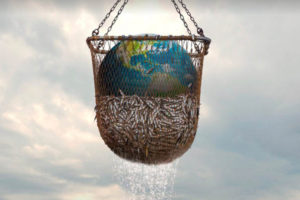
But that number, 70 billion, just scratches the surface. It doesn’t take into account, for instance, the numbers of fish and other sea creatures’ lives we snuff out each year. On fish farms, something like 100 billion animals are killed; at least 790 billion – perhaps nearly 3 trillion! – wild fish are killed every year by the fishing industry.
Indeed, so many fish are being killed each year that scientists have repeatedly warned that ocean fish will be close to wiped out in the next 30 years unless we dramatically change our ways.
These numbers are wildly beyond human imagination. We cannot begin to comprehend the outrageous magnitude of the suffering that we are responsible for.
And still, we haven’t accounted for all of the killing. We raze forests for grazing land and to grow soy and corn to feed farmed animals. Countless wild animals die as a result. In South and Central America, deforestation has caused wild animal populations to plummet a full 89% since 1970.
And then, to top it all off, we also create dead zones.
A dead zone is an area of a lake, bay, or ocean in which most life cannot survive. They occur every year at the mouths of major rivers like the Mississippi river and even in Lake Erie.
Dead zones are seasonal, generally first appearing in the spring and running into summer. They form as the rivers dump the fertilizer and manure running off the land into areas where water flow is slow. This huge pulse of nutrients fuels massive growth of cyanobacteria. These cyanobacteria consume the oxygen in the water and suffocate the sea life that can’t get out of the area in time. Sometimes the cyanobacteria secrete deadly toxins, too, making matters even worse.
Dead zones can be small or they can be absolutely enormous. There are over 400 of them that appear every year. The one at the mouth of the Mississippi commonly reaches 6000 square miles (over 15000 square km), sometimes more. In 2017, the aggregate area covered by dead zones in the world was roughly the size of the European Union. That’s 4.5 million square kilometers. And the problem is growing. The volume of water affected today is four times greater than in 1950!
There is no reliable estimate of the number of sea creatures that are killed by dead zones each year, but there is a good chance that the numbers eclipse even those of fisheries.
And why do dead zones exist? Almost entirely because fertilizer and manure run off the land, collect in rivers, and wash into the sea. And that fertilizer was used mostly to grow feed crops for animals and, to a lesser but still significant extent, to produce biofuels.
Some 67% of all crops grown by American farmers are used to feed farmed animals; that’s some 36% of all of the corn and roughly 98% of soy. Another 40% of the corn is used to make biofuel. Corn is the main recipient of the fertilizers we apply, and soy is not far behind. Clearly, animal agriculture is the main cause of the runoff that creates dead zones.
(As an aside, while we do get food value out of the animals we kill, most of that value is wasted. On average, of every 100 calories fed to a farmed animal, we get only 4 calories back when we eat them. That is, most of the damage we do is done, effectively, for waste.)
Sum this all up, and we are killing at least 1 trillion animals – likely at least twice that – each and every year, and doing enormous ecological damage. And we’re doing it almost entirely to fuel our meat eating habits. Sadly, the extent of our killing is increasing each and every year. This must be reversed.
Since the dawn of civilization, the world’s wild animal populations have dropped by 83%. Indeed, humans and farmed animals now account, by weight, for a whopping 96% of all mammalian life on earth. Chickens, turkeys, and other farmed birds comprise 70% of all bird life in the world by the same measure. If we don’t change, soon there will be pretty much no wild animals left – and our world will degrade ever more quickly.
Our food choices matter. They really do! So let’s do the right thing. Let’s eat plants and leave the animals alone to the very best of our ability. Make this choice and we’ll help create a world that can remain liveable far into the future. The alternative is continued death and destruction on an unimaginable scale.
Photo by NEOSiAM 2021 from Pexels