
When people think about what motivates vegetarians and vegans to avoid animal products, they generally think of three possibilities: animal welfare, the environment and personal health. And usually, that’s right. All are compelling reasons to avoid the use of animal products. But there is another powerful reason to eschew meat, dairy and eggs. Meat is a life and death issue.
We’re not talking about the lives and deaths of the animals who become our food. And we’re not talking about the social justice reasons we commonly consider – although these reasons are compelling enough. Factory farming and modern meat industry in general, have had corrosive effects on rural families’ livelihoods.
The small profits associated with factory farming require that labor costs be kept low. Automated feeding, watering and manure-handling systems have taken over, taking jobs and money out of the farming communities. In the United States, injury rates among slaughterhouse workers are reportedly 3 times the national average, and working conditions are frequently abysmal. All this for an ever dwindling paycheque. Slaughterhouse workers today earn 30-40% less than they did in 1961.
No, we’re not talking about any of this. We’re talking about another terrible aspect of animal agriculture. We’re talking about mass starvation.
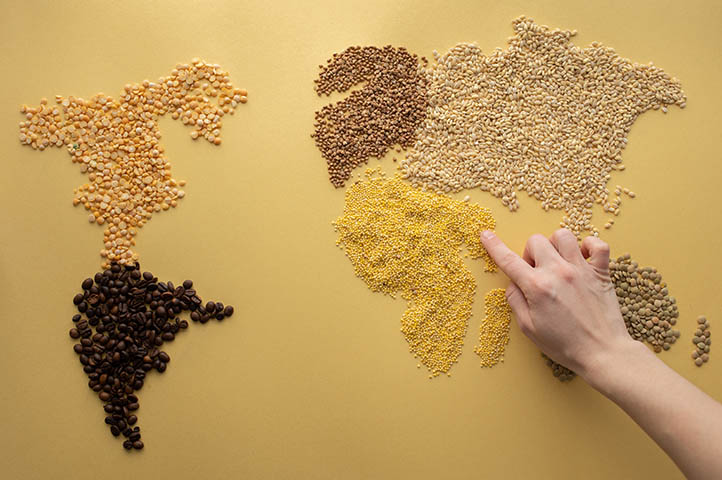
The world is facing a food crisis of unprecedented magnitude. Grain stocks are at record lows. Food prices are skyrocketing. Hundreds of millions of people – Hundreds of Millions of People – are starving. Fully 800 million are on the brink. They cannot afford to feed themselves. And the prospects for a rapid turnaround are dim. A recent report from the United Nations and the Organization for Economic Cooperation and Development tells us that food prices will remain extraordinarily high for at least the next ten years. The UN warns that the world’s bottom billion are about to become the world’s bottom two billion.
This terrible food crisis is rooted in four basic problems. One, our population is growing and the growing numbers of mouths makes feeding them that much more difficult. Two, Australia is experiencing an exceptionally severe drought and that drought has cut deeply into the world’s grain and rice supplies. Three, biofuels are increasingly cutting into our food supplies. As British journalist George Monbiot has pointed out, over 100 million tonnes (110 million tons) of corn and soy will become automobile fuel this year. That’s just plain unconscionable. Biofuels are responsible for about one-third of the price increases for vegetable oils and grains, according to the UN/OECD.
It makes sense to reuse cooking oil as fuel; doing so cuts a bit of our wastage and marginally reduces fossil fuel usage. Dedicating land that would otherwise be used for food to the production of biofuels, though, steals food from the mouths of the poor.
It all pales, though, in comparison to reason number 4 – the amount of corn and soy and other grains that we feed to farm animals so that we can eat meat.
Citing Monbiot again, some 760 million tonnes (that’s well over 800 million tons) of corn and soy will be fed to animals this year. Most of that feed will, quite literally, be wasted. Every time you down a quarter pound hamburger, you’re essentially getting the value of about a quarter pound mix of grain and soy while, at the same time, throwing away about two pounds more. The great majority of the grain and soy fed to farm animals does not become meat. It becomes manure. No human will be fed with that.
And, unfortunately, things are set to get worse. The UN/OECD report predicts that global meat demand will grow an average of 2.5% per year over the next ten years. Meeting that demand will be equivalent to stealing easily 19 million tonnes of food next year out of the mouths of the poor, rising to over 200 million tonnes ten years from now. Clearly, if we allow the trend to continue, a very large swath of humanity will be consigned to horrific and slow deaths.
In his carefully researched new book, The End of Food, Paul Roberts argues that our future indeed is bleak. Modern agriculture is too industrialized. It relies too much on fossil fuel inputs. Food crops are highly inbred; huge losses to disease are inevitable. Farm animals are raised and in too high numbers in too close quarters. Sooner or later disease pandemics will run rampant among them – if grain shortages don’t kill them first.
Roberts argues that system-wide collapse is inevitable. We will respond to this crisis only when it becomes a crisis even for us in the rich West. By then, it will be too late.
But he may be wrong and we can prove him wrong. Grow your own food to the maximum of your ability. Support organic agriculture – in the long run, it’s one of the best hopes for humanity. And most of all, avoid meat and dairy and eggs. As George Monbiot points out, diverting the grain fed to animals to human mouths instead would cover the food deficit 14 times over.
Photo by Monstera on pexels.com