On November 5, the Government of British Columbia announced that it would begin a process to phase out BC’s mink-farming industry due to ongoing public health risks associated with COVID-19. The provincial health order includes the following directives:
- A permanent ban on breeding mink;
- A permanent ban on live mink on farms by April 2023; and
- All operations ceasing completely, with all pelts sold, by 2025.
According to the government’s press release, the decision follows data from the BC Centre for Disease Control, which identified “the potential for the SARS-CoV-2 virus to mutate in mink and be passed to people”, along with “additional concerns that mutations could have an impact on vaccine effectiveness.”
According to the Humane Society International, BC joins a growing list of nations and territories, including Estonia, Hungary and the Netherlands, that have stopped fur farming in their jurisdictions due to serious public health and animal welfare concerns.
Advocacy Efforts
The government’s decision to phase out commercial mink farming in BC was welcomed by a number of organizations, and countless individuals, who have been advocating for such a move. Some organizations who have championed this cause include:
- The BC SPCA, who have been actively campaigning to end the practice of farmed mink.
- The Humane Society International (HSI)/Canada, who have called on the BC government to ban fur farming.
- The Union of BC Indian Chiefs, who called for a moratorium on BC industrial mink farming in April of this year.
- The Fur-Bearers charity, which has consistently called for the end of all fur farming. In their comment following BC’s decision to phase out mink farming, The Fur-Bearers also recommended the ban be extended to the chinchilla farm industry.
- A group of scientists, including David Suzuki, penned a letter to the BC government calling for legislation to phase out fur farming in BC.
Inhumane Practices at Fur Farms
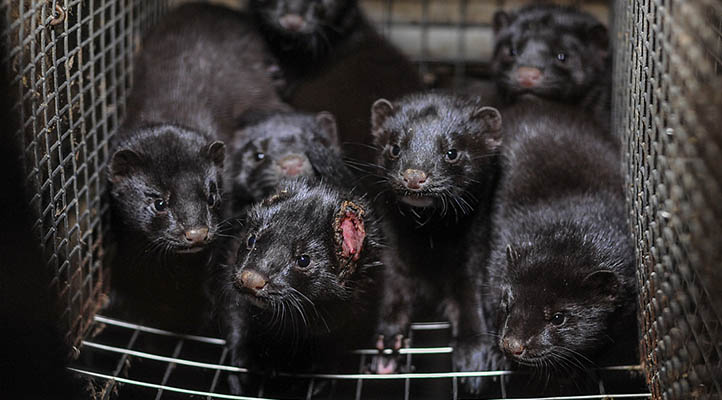
Mink farming is inherently inhumane. The BC SPCA blog post explains that after being weaned from their mothers, mink are housed in small, wire mesh cages. When their fur coats are fully developed in the winter, they are killed on-site at the farm. And to make matters worse, the Fur Bearers organization notes: “Because fur farms do not receive regular inspections by government officials, instances of animal cruelty and neglect are unreported and undetected, resulting in pervasive animal suffering throughout the entire fur farm industry.”
In 2015, Canada’s National Observer published a lengthy, scathing article about Canada’s fur-farming practices. The article exposed devastating conditions experienced by farmed animals. A BC SPCA animal welfare scientist, Sara Dubois, visited a fur farm in BC’s Fraser Valley. Once there, she witnessed mink who were “missing limbs, digits and ears” among the roughly 70,000 mink packed tightly into cages.
According to the 2015 article, since 2011, SPCA branches across Canada have recommended more than 800 provincial and Criminal Code charges of neglect and cruelty against animal owners, but only one Canadian fur farmer has ever been successfully charged.
The aforementioned letter to the BC government from a group of scientists says the following regarding mink in captivity: “Mink are highly intelligent animals who typically roam, swim and forage over a large territory. Confining wild, far-ranging, solitary and semi-aquatic carnivorous animals to small cages causes them extreme stress and frustration.”
COVID-19 Risk
On their website, the BC SPCA provides a comprehensive timeline of COVID-19 infections and responses on BC fur farms. A summary of notable COVID-19 activities is as follows:
- Jan 2021 – 1000 mink culled on BC fur farm after COVID outbreak.
- March 2021 – Breeding resumes in BC despite previous COVID outbreaks.
- May 2021 – Third outbreak of COVID-19 on a mink farm in BC.
- July 2021 – Fourth outbreak of COVID-19 on a mink farm in BC, found via testing of escaped mink. The Public Health Officer places a moratorium on new mink farms (PDF) and the province announces a review of its policies and regulations with respect to fur farms.
- November 2021 – The province announces a phase-out of the mink industry.
The spread of COVID-19 across mink farms was sadly not an isolated issue to BC. Since the spring of 2020, the coronavirus has spread across more than 400 farms in Europe. The Netherlands opted to kill several million animals to prevent further outbreaks, and now aims to shut down the industry by this year (moving up the timeline from 2024). Denmark ordered 17 million healthy and sick mink to be killed in November, in response to outbreaks at more than 200 mink farms. Following this move, the country’s food and agriculture minister stepped down from his role when the order to kill the animals was declared illegal.
In Nova Scotia, the government recently announced it will be paying for COVID-19 vaccines for minks (splitting the cost with the federal government), starting with a trial offering 54,000 doses to five farms. The Canadian Food Inspection Agency granted permission to import an experimental vaccine for mink from the US following discussion with the Public Health Agency of Canada, the provinces and the industry. Tragically for the mink – and us, instead of winding down the mink farm industry, Nova Scotia opted to support it and will offer funding to 24 licensed producers starting in January.
Mink in the wild have also been found to have the virus. In December 2020, the first known case of the novel coronavirus in a non-captive wild animal was confirmed in Utah, among mink located near fur farms with outbreaks.
The Centers for Disease Control and Prevention (CDC) website includes information about mink and SARS-CoV-2. Not surprisingly, the CDC concludes that infected workers likely introduced SARS-CoV-2 to mink on the farms, causing the virus to begin spreading among the densely packed animals. Once the virus is introduced on a farm, spread can occur between mink, as well as from mink to other animals on the farm. The CDC states that there is no evidence that mink play a significant role in the spread of SARS-CoV-2 to people, but “there is a possibility of mink spreading SARS-CoV-2 to people on mink farms”. This is not incredibly surprising, since very few people have direct contact with the animals.The CDC does note that mink-to-human spread of SARS-CoV-2 has been reported in the Netherlands, Denmark, and Poland, and new data suggest it may have occurred in the United States.
Take Further Action
Use Alternatives
Noting again the egregious conditions the mink endure for their entire lives in the fur industry, one of the best ways to take a stand against fur farming of any form is to not purchase, use or wear fur products. Mink oil is also used in various medical and cosmetic products. In the beauty industry, mink hair is often used for fake eyelashes. Many eyelash salons, including many in Vancouver, use authentic mink hair for eyelash extensions.
There are many alternatives available on the market, and it is important to double check to make sure the clothing or beauty products you are purchasing and wearing are completely vegan and cruelty free.
Sign a Petition
While BC ending commercial mink farming is a positive step in the right direction, there are still other types of fur farming taking place in BC and across Canada. According to Statistics Canada, in 2018, there were 98 mink farms and 27 fox fur farms in Canada.
The BC SPCA continues to ask interested individuals to sign their petition to speak out against other types of fur farming.
Please do what you can to prevent the horrific suffering that these innocent animals endure. Not only would it end needless suffering, but it would also reduce the likelihood of disease spread as well.
Photo: Jo-Anne McArthur / Djurrattsalliansen / We Animals Media