By David Steele and Denise Swanson
There’s little doubt about it. Humans evolved as omnivores. The shapes of our teeth, the lengths of our intestines, and a wealth of fossil evidence (arrowheads, butchered animal bones, et cetera) all point to an omnivorous past.
Natural selection favoured meat eating because it allowed our ancestors to survive where edible plant supplies were in short supply. Our forebears could flourish on fruits and grains and berries when those were plentiful and switch to meat when edible plants were scarce. Had early humans not led omnivorous lives, they almost certainly would have died out.
But that was then. This is now.
In the past, humans were few and far between. The pressure we exerted on the world around us was slight. Today, with our population approaching seven billion, the pressures we exert are enormous. No longer a boon to humanity, our hunger for meat has become the single biggest contributor to planetary degradation. Be it global warming, fossil-fuel depletion, water depletion or desertification, meat consumption is a prime factor in the problem. And meat takes food out of the mouths of the hungry.
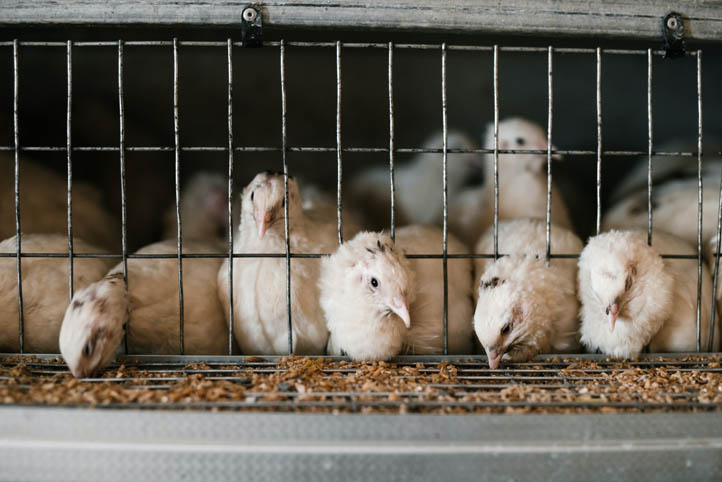
On today’s factory farms, it takes 2.4 pounds of dry corn, soy, and oats to produce a pound of chicken; eight to 10 pounds of similar feed is required for every pound of beef. According to Cornell University’s David Pimentel, nearly 800 million people could fill their stomachs for a year on the grain fed to U.S. animals alone. And that’s just the tip of the iceberg.
According to Pimentel’s careful reckoning, modern western diets could not exist at all were it not for the enormous amount of fossil fuels we pour into them. Just getting nitrogen into our fertilizers takes the equivalent of nearly one million barrels of oil each day. Add in the other components-the pesticides, the herbicides, the combines, the tractors, and all the rest-and the numbers become astronomical. As Pimentel shows, the way we raise meat, it takes some 28 calories of fossil fuel input to generate one calorie of food value. Even modern lacto-ovo vegetarian diets, he warns, can’t be maintained in our world without excessive amounts of oil and gas.
Meat production accelerates global warming, too. All those burned fossil fuels have to go somewhere. Worse, our cows and sheep and other ruminants emit methane as they digest their feed. Together, Canada’s 10 million cows release the methane equivalent of a half ton of CO2 for every man, woman, and child in the country. According to the UN Food and Agriculture Organization, animal agriculture is responsible for a bigger share of global warming than all of the cars and trucks and ships and planes in the world combined!
And animal agriculture emits other pollutants, too. Nearly three-quarters of North American ammonia emissions are due directly or indirectly to animal farming. Manure contaminates our ground water. The Worldwatch Institute reports that farm animals in the United States generate 130 times more bodily waste than humans.
Animal agriculture destroys land and habitat, too. Raising livestock and the soybeans to feed them is easily the biggest contributor to rainforest destruction. More than two acres of tropical rainforest are cleared per second to graze or feed farm animals. Around the world, tens of billions of tons of topsoil are lost each year to cultivation of animal feed crops.
Fish are no solution either. We’ve mined the oceans so badly that almost all of the world’s fisheries are in serious decline. Hunting? Sorry. All of North America’s wildlife would be wiped out were we to satisfy our current hunger for meat that way.
In the past, the meat eating was a boon to us. But today, the opposite is true. Natural selection operates on the here and now. If we don’t curtail our consumption of meat and eggs and milk and cheese, natural selection will eventually work in the strongest way against our meat-eating habits.
But we’re lucky. We evolved as omnivores. We can choose what we eat. Plants or animals.
Choose plants. There’s an awful lot at stake.