
The Intergovernmental Panel on Climate Change (IPCC) hit us with quite the zingers a couple of years ago. They released two new draft reports. The first, Climate Change 2014: Impacts, Adaptation, and Vulnerability, made a very strong case that unless we change our ways quickly and dramatically, human civilization itself is at risk. Without action, we can expect mass crop failures, increasing poverty and war.
The second report, Climate Change 2014: Mitigation of Climate Change, is much more hopeful. The over 500-page tome focuses on what we can do. There is very important advice here – a call to community – and we really ought to listen.
The IPCC’s Mitigation of Climate Change report is a comprehensive overview of our prospects for dealing with climate change. Scientific, technological, environmental, economic and social aspects are all extensively covered. And while much of it does indeed come across as grim, the report actually brims with optimism. Mitigating climate change does not have to be wildly expensive; it has lots of side benefits; it will prevent the very nasty outcomes.
The problem, though, is that pretty much every current trend is in the opposite direction to what we need. Greenhouse gas (GHG) emissions have been skyrocketing. Over half of all cumulative GHG emissions since 1750 have occurred since 1970. Amazingly, annual emissions averaged two and a half times higher from 2000 to 2010 than from 1970 to 2000. If current trends continue, we can expect a world 2.6°C to 4.8oC warmer in 2100 than it is today – and warmer still in the years after that.
The reasons for these discouraging trends are complex, but largely explained by the increasing wealth and population across the world, combined with very poor energy choices. Highly polluting coal is ever more popular in the developing world (where it underwrites our cheap consumer goods), as is oil extracted from the Alberta tar sands.
The IPCC warns us that to avoid the worst effects of global warming, we need to keep the total amount of warming since preindustrial times to below 2o C. We’re nearly halfway there already. To accomplish this goal, they point out, we’ll need to get roughly a quarter of our energy from low carbon sources (like wind and solar) by 2030, and 40–70% by 2050. The good news, the report highlights, is that we can accomplish this with technology that already exists and doing so will not hurt our economies. Really. According to the report, we’d shave only about 0.06 percent off of the world’s expected economic growth this century (though we would spend more now to save even more later).
So why aren’t we doing it? The main reason, the IPCC tells us, is that we’re not cooperating. Countries see themselves as in competition with each other. Instead of working together, we’re prioritizing short term domestic prerogatives over the long term well-being of us all. There are laudable aspects to some of this, of course, such as the efforts of many countries to reduce poverty. But most of it is just plain selfishness.
Canada is one of the worst offenders. Back in 1997 we pledged to cut greenhouse gases by some 6 percent below 1990 levels by 2012. But rather than deal with our wasteful lifestyles (we use more than twice as much energy per capita as any country in Europe) and because of our decision to massively exploit the tar sands, we did worse than nothing. In 2009 our emissions were 17 percent higher than in 1990. By 2020, we’re looking at even worse than that.
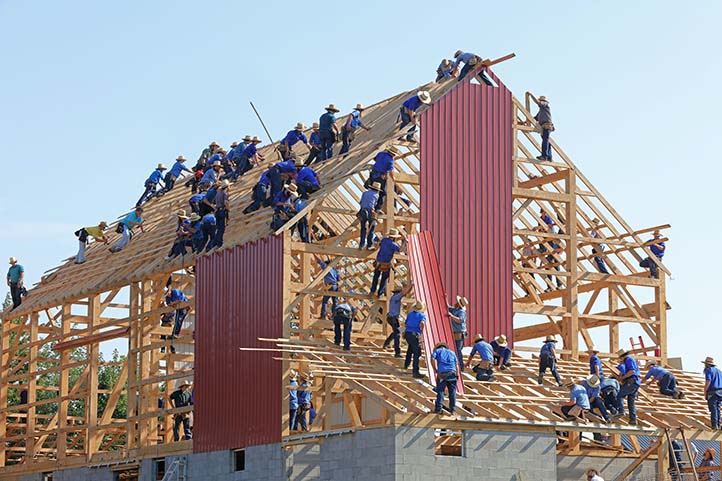
Fundamentally, the solution the IPCC promotes is simple. We need to concern ourselves with the well-being of every one of us – individuals and nations – in this world. We have to care. To tackle global warming, we must act as a global community. This is not exactly an unprecedented idea, and we know that it can work. We’ve done it before for acid rain and the ozone holes at the north and south poles, and we can do it again. And there will be some very good side effects.
The IPCC warns that continuing with the status quo essentially guarantees that our economies will slow down; it will “make poverty reduction more difficult, further erode food security, and prolong existing and create new poverty traps.” Taking appropriate global action will do quite the opposite. The IPCC well documents that if we work together, rather than at cross-purposes, we can reduce world poverty and develop or maintain high quality lifestyles while dramatically reducing our reliance on fossil fuels.
A transition to a low carbon world is essential and urgent, but it needs to be equitable. Fossil fuels must be taxed across the world and subsidies underlying them must be removed. Cap and trade schemes like those popular in Europe haven’t worked, the report says, but carbon taxes have. Revenue neutral carbon taxes, like the one in British Columbia, are favored by the IPCC. Realistically, though, since we need to invest massively in renewable energies, and that will cost money, revenue neutral may be too much to ask.
That said, these climate change mitigation costs can be held down by the implementation of a few simple public policy and lifestyle changes. Moves towards public transportation, bicycling and walking, for example, can be quite cheap. A fortune in road maintenance costs could be saved. High speed rail would be a not-too-expensive replacement for short haul jet flights, which are extremely carbon-intensive. Solar panels, which are becoming cost competitive with fossil fuel-derived electricity, could provide much of our electricity.
The most cost effective measure, though, is likely a bit of a surprise. As highlighted in Chapter 11 of the IPCC Mitigation of Climate Change report, a simple move, across the world, to drop animal products from our diets, would save a fortune. In fact, it would slash global warming mitigation costs fully in half. We’d get the same nutrition as we do now from a lot less land. GHG emissions would be directly reduced and the growth of trees and other vegetation on the rewilded farmland would take a lot of carbon out of the air. There’d be a huge boost to food security as well.
So really, it’s not that hard.
The prospects if we fail to act are grim. Global warming is already having clear negative effects on the environment, on agriculture and on human health. Droughts and other extreme weather events are more common. Our oceans are acidifying. Sea levels are rising. Things will get much worse unless we act now. We’ve waited a long time, but our prospects are still good if we do.
So let’s get cracking. Let’s lobby our governments to enter into a global cooperative agreement that meets the challenge we face. And let’s change our personal lifestyles to match what we know we must do. If our governments see that the people are on board, they will be all the more likely to act themselves.
An earlier version of this article appeared in The Aquarian in the spring of 2014. That version can be found here: http://www.aquarianonline.com/it-takes-a-global-community/
Photo by Randy Fath on Unsplash